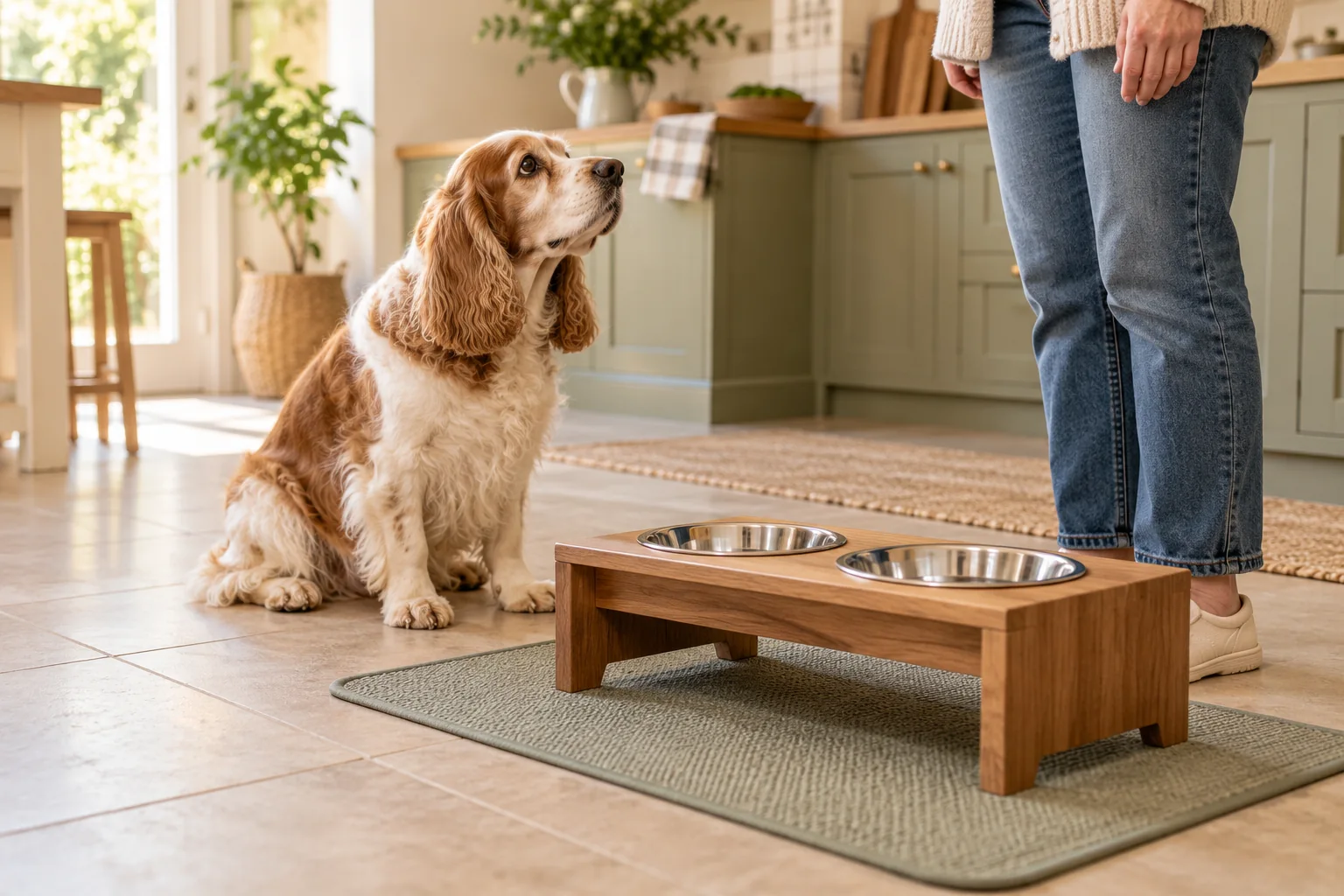
The best raised dog bowls for senior dogs are options to consider only after deciding whether elevation suits the individual dog. Age alone is not a reason to raise a bowl. If your dog struggles to eat or drink, ask your veterinary team about the cause, appropriate positioning and feeding-related risks before choosing equipment.
This guide compares five feeders by access, stability features and cleaning. It does not recommend raised feeding for every senior dog or adopt manufacturers’ digestion, pain-relief or bloat-prevention claims.
Read this before buying an elevated feeder
Raised bowls do not have an established role in preventing bloat. Cornell University’s GDV guidance lists raised food bowls among potential risk factors and advises avoiding them. The American College of Veterinary Surgeons also notes that elevated feeding has been suggested to increase incidence. This deserves particular discussion for large and deep-chested dogs and dogs with an affected close relative.
A 2000 prospective study of large and giant breeds found raised feeding associated with increased GDV risk. Association does not prove that the feeder caused an individual case, and the study does not establish the same risk for every dog. It also does not justify marketing elevated bowls as protective. Ask your vet to weigh the dog’s circumstances and any specific positioning need.
Unproductive retching, a swollen abdomen, marked distress or collapse can indicate an emergency. Seek immediate veterinary care if GDV is suspected; changing the bowl is not a response to those signs.
Five elevated feeders to discuss and compare
| Product | Reason to compare | Manufacturer-stated details | Check carefully |
|---|---|---|---|
| WeatherTech Double High Pet Feeding System | Matched stand, bowls and spill mat | 3–14 in listed fixed-height configurations · two bowl material options | Veterinary decision first; choose exact height and allow for the complete mat footprint. |
| Neater Feeder Deluxe for Dogs | Spill collection with splash walls | Dog sizes: 3 / 5 / 8 in bowl-rim height before optional extensions | Empty and clean catch basin; overall splash-guard height differs from feeding height. |
| OurPets Raised Healthy Diner — 12-inch model | Open two-bowl layout to verify | 12 in model listed · removable dishwasher-safe stainless-steel bowls | Confirm exact SKU, rim height and bowl capacity directly; source capacity text is inconsistent. |
| Petmate Easy Reach Diner — Extra Large | Tall fixed stand with lifting handholds | 28.3 × 13.6 × 14.5 in overall · removable steel bowls | Overall height is not a prescribed feeding height; check bowl rim and stand stability. |
| Fluff Trough Stainless Steel Set — Original | Open-front access for smaller dogs | 2-cup removable steel insert · base and four silicone feet | Original and XL differ; optional extensions change height and water may need a separate station. |
Specifications checked October 17, 2026. Fit labels are editorial judgments, not hands-on test awards. Swipe or scroll to view every column.
Product heights are manufacturer dimensions, not prescribed feeding heights. A stand’s maximum height, bowl rim and food surface are different measurements. The appropriate arrangement may remain a stable floor-level bowl.
How we compared these feeders
We checked linked manufacturer pages on October 17, 2026 for construction, available formats and maintenance. We have not tested these feeders with dogs, measured tipping resistance or established clinical benefits. “Reasons to compare” describe design differences; they are not medical endorsements or performance awards. Confirm the selected model and instructions before purchase.
Our research-based shortlist
WeatherTech Double High Pet Feeding System
WeatherTech Double High combines two bowls, a stand and a fitted spill-containment mat. Its listed stand options range from three to fourteen inches, with stainless-steel or plastic bowl selections. The manufacturer says the complete system is dishwasher safe.
Compare the complete footprint, including the mat, rather than only the bowl diameter. Choose a specific configuration after veterinary guidance; the range does not make one stand infinitely adjustable. The raised mat lip is also an edge in the dog’s standing area. Keep it out of the approach and check stability on your actual floor.
- Integrated stand and mat.
- Several fixed-height configurations.
- Mat adds floor space and an edge.
- Select exact height and bowl variant.
Manufacturer source; no hands-on test claim. Verify the exact model and current instructions.
Neater Feeder Deluxe for Dogs
Neater Feeder Deluxe uses raised splash walls and a lower basin to collect spilled water separately from food. The dog sizes list bowl-rim feeding heights of three, five or eight inches before optional extensions. Those are lower than the overall splash-guard heights shown for the units.
This design is worth comparing for spill management, provided your dog can approach the bowls comfortably. The basin requires frequent emptying and cleaning; captured water is still water that needs attention. Choose the dog size and exact bowls deliberately. The Cat version has different bowl geometry, and adding extensions changes the access decision.
- Separate spill basin.
- Explicit bowl-rim measurements.
- More components to clean.
- Splash walls can constrain approach.
Manufacturer source; no hands-on test claim. Verify the exact model and current instructions.
OurPets Raised Healthy Diner — 12-inch model
The OurPets Raised Healthy Diner page identifies a twelve-inch model with removable stainless-steel bowls. Its simpler open feeding layout provides an alternative to a high splash enclosure. The manufacturer also describes a bottle-fed water feature.
Confirm the exact SKU, rim height and bowl capacity directly before ordering: the linked page’s capacity description does not read consistently with its twelve-inch model heading. We therefore omit a capacity claim. A bottle attachment is not a substitute for checking and cleaning drinking water. If precise dimensions remain unclear, choose a feeder with verifiable specifications instead.
- Removable steel bowls.
- Unenclosed bowl access.
- Fixed twelve-inch model needs careful fit.
- Capacity requires direct confirmation.
Manufacturer source; no hands-on test claim. Verify the exact model and current instructions.
Petmate Easy Reach Diner — Extra Large
Petmate Easy Reach Diner combines a molded plastic stand with removable dishwasher-safe stainless-steel bowls. Rubber bowl inserts are intended to reduce rattling, and side handholds help a caregiver lift the empty unit for cleaning. The linked Extra Large lists an overall height of 14.5 inches.
That substantial fixed height makes it a very different comparison from a low feeder. Overall height is not a veterinary fit measurement. Check the bowl recess, actual rim and approach space. Bowl-retaining inserts also do not establish resistance to sliding or tipping on your floor. We do not adopt the page’s broad clinical claims about digestion and joints.
- Removable steel bowls.
- Caregiver lifting handholds.
- Tall fixed Extra Large format.
- Check stand stability separately.
Manufacturer source; no hands-on test claim. Verify the exact model and current instructions.
Fluff Trough Stainless Steel Set — Original
The original Fluff Trough Stainless Steel Set includes a base, a removable two-cup steel insert and four silicone feet. Its broad, open-front format differs from a round bowl recessed in a two-bowl station. Optional leg extensions are separate height-changing components.
The manufacturer describes this version for small to medium dogs; do not transfer its dimensions or capacity to the larger XL family. Consider whether the open front and insert depth match the dog’s reach, and plan a separate drinking point if needed. Clinical claims about choking, vomiting or reflux are not established by this comparison and should not guide treatment.
- Open-front access.
- Removable steel insert.
- Original size has two-cup capacity.
- Single station may require separate water setup.
Manufacturer source; no hands-on test claim. Verify the exact model and current instructions.
Select access for the dog, not a universal height rule
Describe the problem to your vet in observable terms: the dog spreads the front feet, stops midway through a meal or struggles to reach a particular bowl. A short video of normal feeding may help if your team requests one. Do not repeatedly create a difficult feeding position to demonstrate it.
Ask whether elevation is appropriate, what position to aim for and what changes should trigger review. There is no single number of inches below the shoulder that this guide can prescribe safely for all dogs. Manufacturer shoulder-height charts can help identify a product configuration after that decision; they cannot make the medical decision.
Check the bowl opening and depth as well as height. A tall rim can still surround a deeply recessed food surface. The dog should have space to stand and leave without squeezing between furniture. Avoid makeshift stacks of boxes or unsecured platforms to adjust a poor fit.
Plan the whole feeding area
Inspect the empty feeder for rocking, loose components and exposed edges before introduction. Follow the assembly instructions and check it on the actual surface. “Non-slip feet” and bowl-retaining rings address particular contact points; neither guarantees the complete station cannot move.
Keep the approach dry and stable, including the area where the rear feet stand. Our flooring comparison explains backing and edge checks. A feeder mat that curls at the entrance creates another obstacle even if it catches drips.
Allow quiet access away from household traffic and competing pets. If the dog must cross a difficult room to reach water, repositioning or another clean drinking point may help more than a taller stand. Use the home safety walkthrough to connect feeding, rest and outdoor access.
Make cleaning part of the purchase decision
Identify every removable part and its permitted care method. Dishwasher-safe bowls do not automatically make the entire stand dishwasher safe. Inspect rubber rings, feet, recesses and spill basins, and replace damaged parts according to the maker’s instructions.
Do not let a water reservoir or a hidden catch basin turn into a forgotten cleaning task. Refill and clean drinking points routinely, and discuss changes in drinking, appetite or swallowing with the veterinary team. A feeder is an access tool, not an explanation for new symptoms. For wider spending priorities, consult our mobility buying guide.
Frequently asked questions
Do raised bowls prevent bloat?
No protective effect is established here. Published observational evidence has associated raised feeding with increased GDV risk, and Cornell advises avoiding raised bowls. Discuss individual risks and any positioning need with your vet.
Should every dog with arthritis use an elevated feeder?
No. A diagnosis or senior age does not determine one feeding setup. Ask about the dog’s actual difficulty, suitable positioning and feeding-related risks.
Is an adjustable feeder automatically the best choice?
Only if the permitted configuration is stable and suits the agreed position. Adjustment adds choices, not clinical evidence. Some products require separate extensions rather than continuous adjustment.
Can I use these bowls for a swallowing disorder?
A swallowing or esophageal condition needs a veterinary feeding plan. Do not substitute an ordinary raised stand for prescribed positioning or specialist equipment.
Sources and verification
- Product links support maker construction details; checked October 17, 2026.
- American College of Veterinary Surgeons: GDV — risks and emergency context.
- Cornell University: GDV or bloat — signs, risk factors and prevention guidance.
- Glickman and colleagues, JAVMA, 2000: non-dietary GDV risk factors — prospective cohort, not a randomized feeder trial.
About the author
Grace Wilder
Grace Wilder writes about senior-dog mobility and everyday comfort for PawRampGuide. She covers dog ramps, support harnesses, orthopedic beds, and practical home adjustments, focusing on product fit, ease of use, and clear comparisons. Her goal is to help owners make thoughtful choices that support their aging dogs’ daily routines. Her articles provide general information, with individual health and mobility decisions guided by a veterinarian.