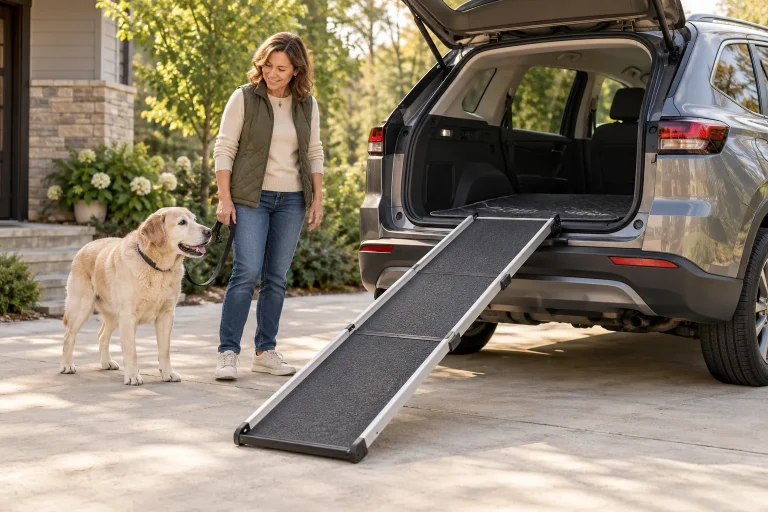
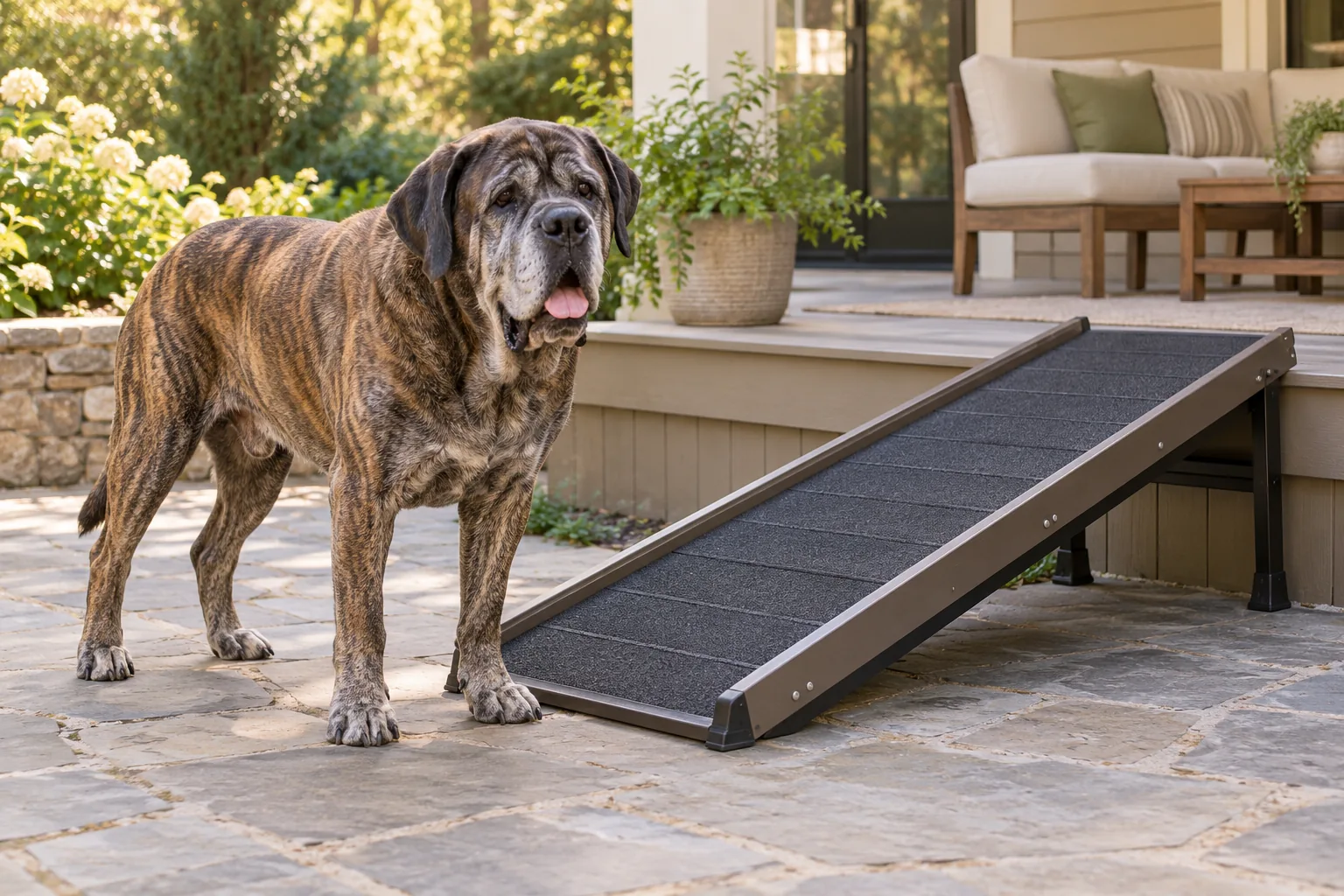
For a large senior dog, ramp shopping begins with walking room and controlled movement, then load capacity. A ramp can carry the dog’s stated weight yet still be too narrow for their usual gait, too steep at the intended landing, or too awkward for the caregiver to position. A high capacity cannot resolve those other problems.
The five ramps below cover broader straight designs, compact storage and a segmented alternative. They are options to measure against your dog’s needs, rather than a ranking that declares one model suitable for every Labrador, German Shepherd or giant breed. Published widths are outer dimensions unless the manufacturer says otherwise; request the clear tread measurement before relying on them.
Ask your veterinarian about new limping, weakness, hesitation or balance changes. Cornell lists ramps and non-slip rugs among possible home changes within a broader osteoarthritis treatment plan, but an individual dog still needs assessment. Equipment does not diagnose pain or replace treatment.
Large senior-dog ramp comparison
| Product | Reason to compare | Manufacturer-stated details | Check carefully |
|---|---|---|---|
| PetSafe Happy Ride Extra Long Telescoping Ramp | More reach and broader outer width to assess | 47–87 in long · 20 in wide · 18 lb ramp · 300 lb stated capacity | Confirm clear tread and caregiver control of the long stored item. |
| Pet Gear Extra Wide supertraX Tri-Fold Ramp | Broader tri-fold option with a removable surface | 71 × 19.5 in · 200 lb stated capacity · carrying weight requires confirmation | Verify 200-lb rating for the model; official carrying-weight figures conflict. |
| WeatherTech EasyRamp | Individual-component carrying routine | 94 in assembled · 15 in section width · under 21 lb assembled · 300 lb stated capacity | 15-in sections and a 10-in-long platform may constrain a large dog’s route. |
| WeatherTech PetRamp | Single folding item at a compatible landing | 67 × 15 in · 16 lb ramp · 300 lb stated capacity | 300-lb capacity does not establish fit on a 15-in outer width. |
| PetSafe Happy Ride Compact Telescoping Dog Ramp | Shorter storage where gait and geometry also fit | 28–70 in long · 16 in wide · 14 lb ramp · 300 lb stated capacity | Compact storage cannot compensate for insufficient walking room or reach. |
Specifications checked October 17, 2026. Fit labels are editorial judgments, not hands-on test awards. Swipe or scroll to view every column.
This research-based guide uses manufacturer documentation checked October 17, 2026. We have not performed hands-on load, traction or durability tests, and we do not claim a consensus from owner reviews. Load ratings are manufacturer statements for pets. Prices and retailer availability are not established here.
Five designs and their large-dog tradeoffs
PetSafe Happy Ride Extra Long Telescoping Ramp
Compare the XL when you need both a longer straight approach and a broader starting width than compact vehicle ramps provide. Its 20-inch outer dimension is promising only if the usable tread accommodates your dog’s actual foot placement. Ask how much width the side edges occupy, and watch whether the dog normally walks with the rear feet offset from the front.
The other half of the decision is deployment. A caregiver must manage its 47-inch stored length and 18-pound stated weight while the dog waits securely elsewhere. If the dog needs continuous support and there is only one person available, write out the entire sequence before assuming the ramp solves loading. More reach does not provide a second pair of hands.
- Longer straight format for reducing incline where space permits.
- Broader outer width than several portable alternatives.
- Clear tread width still requires confirmation.
- Long stored item may be awkward during assisted travel.
Manufacturer source; no hands-on test claim. Verify the exact model and current instructions.
Pet Gear Extra Wide supertraX Tri-Fold Ramp
The Extra Wide supertraX Tri-Fold offers a 19.5-inch listed width and a removable walking mat. That makes it worth measuring for a dog whose route feels crowded on narrower equipment. A removable surface also lets you inspect underneath and clean according to the manufacturer’s instructions instead of repeatedly covering a worn tread with improvised material.
Its stated 200-pound capacity still needs comparison with your dog’s current weight and the exact model documentation. Do not confuse this version with similarly named Pet Gear ramps. Carrying weight is unresolved: the official page states 24 pounds in one place and 27 in another. Obtain a model-specific answer if lifting ability is central to your purchase.
- Broader published width for further gait assessment.
- Removable mat and tri-fold storage.
- Manufacturer carrying-weight figures conflict.
- Fixed length limits how much the incline can change.
Manufacturer source; no hands-on test claim. Verify the exact model and current instructions.
WeatherTech EasyRamp
EasyRamp separates into two ramps and a central stool, which can change how a caregiver carries the equipment. Evaluate each component’s shape and where it will be stored; total assembled weight alone is not a useful description of that handling routine. Assemble everything before bringing the dog to the route.
For a large dog, scrutinize the walking sections and platform rather than assuming the 94-inch assembled measurement means a long, broad runway. Each ramp section is listed at 15 inches wide, and the central top is only 10 inches long. Ask your veterinary team whether your dog can manage the changes in slope and remain aligned through that transition. The platform should not be treated as a generous turning area.
- Separate components may suit a particular carrying routine.
- Different layout from a single straight slope.
- Fifteen-inch sections may restrict a broad or drifting gait.
- Central support and transitions need individual assessment.
Manufacturer source; no hands-on test claim. Verify the exact model and current instructions.
WeatherTech PetRamp
PetRamp is the simpler folding alternative for someone who wants one item to unfold and store. Its stated 300-pound pet capacity may cover the weight of many large dogs, but its 15-inch outer width can be the limiting dimension. The important comparison is with clear tread, not the dog’s chest measurement or a product photograph.
At a compatible lower landing, the fixed 67-inch format may work within a manageable footprint. At a higher one, it may create an approach the same dog cannot comfortably negotiate. Check ascent and descent separately, including whether there is enough space beside the ramp for the caregiver’s approved support position. The handler should not stand on the ramp to create that space.
- One folding assembly with a stated 33.5-inch folded length.
- Published carrying weight and pet capacity.
- Narrower published width than the broader options here.
- Fixed length cannot be extended for a higher landing.
Manufacturer source; no hands-on test claim. Verify the exact model and current instructions.
PetSafe Happy Ride Compact Telescoping Dog Ramp
A large dog’s travel equipment can leave little room for a ramp. The Compact’s 28-inch stored length addresses that storage problem, while its stated 300-pound pet capacity does not by itself answer the walking-fit question. Ask for clear tread width and compare the 70-inch maximum extension with your measured landing.
PetSafe lists this model for vehicles up to 28 inches tall. Even within that limit, a dog with a broad stance or trouble keeping a straight line may need a different route. Choose this design only when compact storage, supported geometry and comfortable foot placement all agree; saving cargo space is not enough if the dog repeatedly crowds the edge.
- Short stored format leaves more room for other equipment.
- Lighter stated carrying weight than the XL.
- Less width and maximum reach than the XL.
- Not designed around every tall vehicle entry.
Manufacturer source; no hands-on test claim. Verify the exact model and current instructions.
Measure the dog’s walking route, not just body width
A dog’s shoulders do not show where all four paws land. On a familiar, level, non-slip surface, observe ordinary walking without deliberately making the dog turn or perform difficult movements. Note whether the rear feet track straight, the dog takes a wider stance, or the body drifts sideways. Share a short video with the veterinary team if they request one.
Ask the manufacturer for the narrowest usable tread measurement, including near hinges, telescoping overlaps and the upper transition. A broad external measurement can conceal raised edges or a narrowed contact area. Then discuss those measurements alongside the dog’s movement, rather than applying an arbitrary extra-width allowance that has no individual assessment behind it.
Edges can help define the route, but low side rails are not a containment system or a substitute for supervision. A dog who needs a person to prevent a fall requires a handling plan that the caregiver can actually follow. If maintaining alignment looks difficult on level ground, seek advice before testing it on an elevated slope.
Understand what capacity does and does not mean
Use a recent weight and the manufacturer’s rating for the exact model. When the dog approaches a stated limit or the documentation is unclear, ask the manufacturer for guidance rather than inventing a safety multiplier. Capacity information does not establish how much the surface will flex, how secure the dog will feel, or how the ramp behaves in your particular setup.
Use the ramp for one dog at a time, following its instructions. A combined weight below the advertised limit does not make two dogs crossing together sensible: they can block each other or change direction. Likewise, the pet rating does not authorize a person to walk on the ramp with the dog or stand on it to test strength.
Plan support without relying on a last-second lift
Write down who positions the ramp, who keeps the dog waiting, where any approved support harness is fitted, and how the dog becomes secured inside the vehicle. If the sequence requires one person to hold the dog and unfold equipment simultaneously, change the routine or arrange help. A heavy dog should not have to wait at an open exit while the ramp is still being assembled.
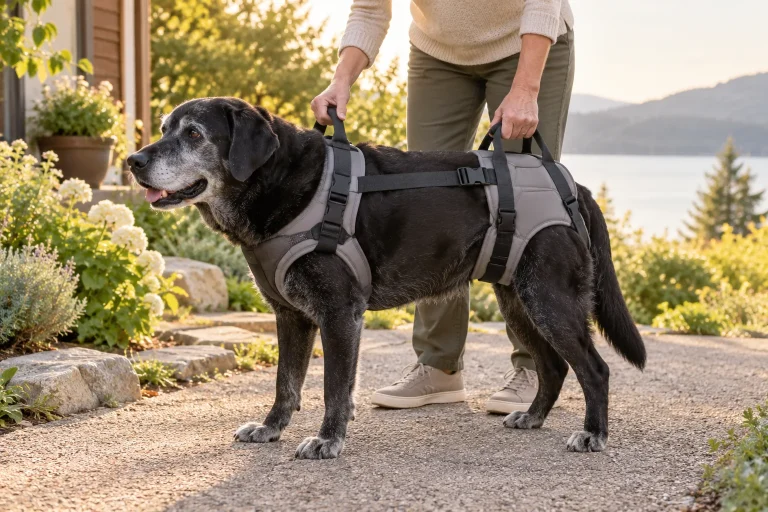
Ask the veterinary team whether support is needed and which technique is suitable. Our support-harness comparison explains product formats, but it cannot select a lifting technique for your dog. A harness also needs room around the handler; adding one does not widen a narrow ramp.
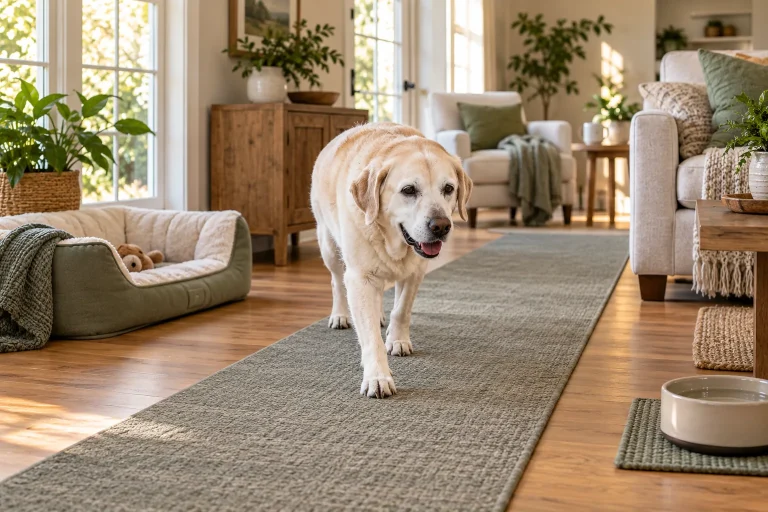
Check the full travel route using our SUV and truck ramp guide. At home, traction and floor-level rest areas may remove unnecessary elevated journeys altogether. Keep essential access separate from optional furniture climbing.
Make first use a measured decision
Inspect the delivered model, contact points and operating parts before the dog approaches. Learn its storage and deployment sequence independently. Introduce the surface gradually in a configuration permitted by its instructions, keeping within the dog’s activity advice. The ramp-training guide provides a voluntary progression rather than a deadline for success.
Record whether the dog can line up, cross and finish the transition without slipping, crowding an edge or needing unexpected help. Stop when movement looks painful or unsafe. A refusal may reflect physical difficulty, uncertainty or both; do not increase force to determine which. Reassess the plan if the dog’s gait, weight or support needs change.
Frequently asked questions
How wide should a ramp be for a large senior dog?
There is no single measurement that fits every large dog. Compare the narrowest clear tread with the dog’s normal foot placement and support needs. Outer width and breed labels cannot establish an individual fit.
Is a 300-pound capacity enough for my dog?
It answers only part of the question. Check your dog’s weight against the exact model’s instructions, then assess width, incline, transitions and caregiver handling. Ask the manufacturer about an unclear or borderline rating.
Should I choose the widest ramp available?
Usable width matters, but the ramp must also have compatible support, suitable reach and a manageable storage routine. A wide ramp that creates an awkward landing or cannot be positioned correctly is not a complete solution.
Can a ramp treat arthritis in a large dog?
No. A suitable ramp can be one environmental adjustment within veterinary care. Cornell describes osteoarthritis management as a combination of approaches; equipment does not replace assessment or prescribed treatment.
Sources and verification
- PetSafe XL, Compact and telescoping-ramp support — dimensions, ratings and operating guidance.
- Pet Gear Extra Wide supertraX Tri-Fold — specifications and unresolved carrying-weight discrepancy.
- WeatherTech PetRamp and EasyRamp — published measurements and design.
- Cornell University: Osteoarthritis — clinical assessment and environmental changes within a broader treatment plan.
About the author
Grace Wilder
Grace Wilder writes about senior-dog mobility and everyday comfort for PawRampGuide. She covers dog ramps, support harnesses, orthopedic beds, and practical home adjustments, focusing on product fit, ease of use, and clear comparisons. Her goal is to help owners make thoughtful choices that support their aging dogs’ daily routines. Her articles provide general information, with individual health and mobility decisions guided by a veterinarian.