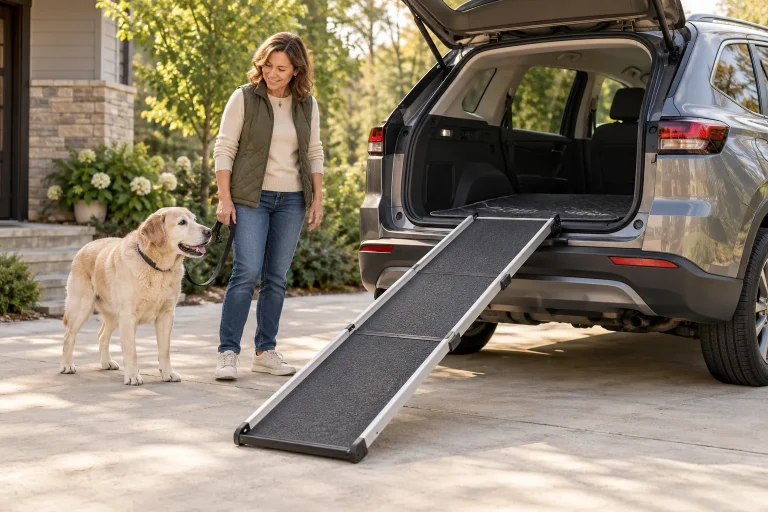
A ramp is an option after surgery only when your dog’s surgeon approves the specific route and handling. Some recovering dogs need carrying or another assisted transfer instead; others may be cleared for a carefully controlled ramp crossing for essential access. Permission to walk for a toilet break does not automatically include permission to climb into a vehicle.
This guide compares five commercially documented ramps to discuss with your surgical team. None is designated a medical recovery device here, and none has been shown by our research to speed healing or prevent surgical complications. The useful question is which, if any, fits the restrictions, vehicle and caregiver arrangement in your dog’s discharge plan.
Five ramps for a surgeon-approved access plan
| Product | Reason to compare | Manufacturer-stated details | Check carefully |
|---|---|---|---|
| PetSafe Happy Ride Extra Long Telescoping Ramp | Discuss for a cleared transfer needing longer straight reach | 47–87 in long · 20 in wide · 18 lb ramp · 300 lb stated capacity | Surgeon must approve the incline, transition and assistance plan. |
| PetSafe Happy Ride Compact Telescoping Dog Ramp | Discuss for a cleared lower entry with limited storage | 28–70 in long · 16 in wide · 14 lb ramp · 300 lb stated capacity | Storage convenience does not establish postoperative walking suitability. |
| PetSafe Happy Ride Folding Ramp | Discuss when lighter equipment and a lower landing both fit | 62 × 16 in · 10 lb ramp · 150 lb stated capacity | Shorter length and 150-lb pet rating may exclude the required transfer. |
| WeatherTech PetRamp | Discuss a repeatable folding setup after route clearance | 67 × 15 in · 16 lb ramp · 300 lb stated capacity | Check gait, protective equipment and support around the 15-in outer width. |
| Pet Gear Extra Wide supertraX Tri-Fold Ramp | Discuss broader tread needs and compatible tether use | 71 × 19.5 in · 200 lb stated capacity · carrying weight requires confirmation | Surgeon clearance and a confirmed carrying weight are both required. |
Specifications checked October 17, 2026. Fit labels are editorial judgments, not hands-on test awards. Swipe or scroll to view every column.
All product-fit labels in this article are conditional on medical clearance. We checked manufacturer documentation on October 17, 2026; this is a research-based comparison without hands-on testing. Capacities are manufacturer pet-load statements. Confirm clear tread width, exact model instructions and current seller availability before buying.
Obtain route-specific advice before choosing equipment
Restrictions vary with the operation and the dog. The American College of Veterinary Surgeons describes several weeks of activity restriction after cruciate surgery and individualized rehabilitation planning. Its fracture guidance warns that a dog may want to use a limb before the repair is sufficiently healed. Cornell describes initial crate rest and tightly controlled exercise following spinal surgery. These are reasons to ask for a personal plan, not schedules to transfer between procedures.
Tell the team whether the proposed crossing is for discharge, a follow-up appointment or daily toilet access. Bring the measured rise, usable ramp length, landing details and photographs. Ask whether ascent and descent are both permitted, what assistance is required, and what to do if the dog refuses or cannot complete the route. A useful answer should describe the task, rather than simply saying to avoid jumping.
If the dog cannot use the proposed setup within those instructions, ask the clinic to help arrange another transfer. Do not improvise a lifting method from a shopping guide or make the first postoperative journey an experiment with unfamiliar equipment.
How the five options differ
PetSafe Happy Ride Extra Long Telescoping Ramp
Consider the XL when the surgeon permits a straight ramp crossing and the necessary vehicle entry needs more usable length. Its longer format gives you more scope to discuss geometry than a shorter fixed ramp. PetSafe lists a maximum vehicle height of 36 inches, but staying within that limit does not establish medical suitability.
Show the team the complete setup, including the top lip and the handler’s position. The caregiver also needs a plan for its long stored form while the dog remains secured. If the dog requires uninterrupted support, arranging a second person may matter more than the ramp’s extra reach.
- Longer straight approach for a compatible essential transfer.
- Broader listed width than the compact alternatives.
- Surgeon must assess incline, transitions and assistance.
- Caregiver must manage storage and deployment separately from the dog.
Manufacturer source; no hands-on test claim. Verify the exact model and current instructions.
PetSafe Happy Ride Compact Telescoping Dog Ramp
Compare the Compact when medical travel supplies leave limited storage space and the approved landing is within its published vehicle-height limit of 28 inches. Its short stored form may be practical for repeated checkups. That convenience is useful only after its walking width and incline meet the individual plan.
Check whether a prescribed support device and the caregiver’s hand position can be managed beside the ramp. The ramp itself does not create room between neighboring cars. Tell the clinic if its parking arrangement cannot accommodate your setup, rather than shortening the deployed ramp solely to squeeze into a bay.
- Compact storage beside other recovery equipment.
- Lower stated carrying weight than the XL.
- Narrower tread arrangement may limit supported walking.
- Reduced reach can make a high entry unsuitable.
Manufacturer source; no hands-on test claim. Verify the exact model and current instructions.
PetSafe Happy Ride Folding Ramp
The Folding Ramp is the lightest option in this shortlist by published carrying weight. Discuss it when the caregiver needs a manageable single folding item and the essential landing is low enough for a surgeon-approved route. Its stated pet capacity is 150 pounds, so it is not an interchangeable replacement for every higher-capacity model.
The shorter 62-inch format is the principal limitation. A caregiver-friendly weight cannot justify an incline the dog is not permitted to use. Verify both ends of the transfer: a low support point can still leave a step into the vehicle that the surgical plan does not allow.
- Ten-pound stated weight reduces the equipment being lifted.
- One folding assembly for a compatible lower entry.
- Shorter length may rule out the intended transfer.
- Lower stated pet capacity than the other options here.
Manufacturer source; no hands-on test claim. Verify the exact model and current instructions.
WeatherTech PetRamp
The fixed-length PetRamp may suit a cleared route where a folding design is easier to deploy than sliding sections. Establish the support arrangement before discharge, and show the veterinary team the actual final step into the vehicle. A 300-pound pet rating does not provide evidence about postoperative gait or surgical outcomes.
Its 15-inch outer width needs close attention if the dog wears a recovery collar, walks off-center or needs hands-on support. Ask the team how the prescribed collar and any approved harness should be managed during transfer. Do not remove or alter protective equipment simply to make a narrow route work.
- Simple folding layout for a repeatable, cleared route.
- Published dimensions support a concrete pre-discharge discussion.
- Narrower outer width can constrain alignment.
- Fixed length leaves no extension option.
Manufacturer source; no hands-on test claim. Verify the exact model and current instructions.
Pet Gear Extra Wide supertraX Tri-Fold Ramp
The wider supertraX Tri-Fold is an option to measure when the team wants more walking room and the vehicle permits the supplied tether arrangement. Its removable mat may be useful for routine cleaning. Neither the surface description nor the wider label establishes that a dog with an altered gait can use it safely.
Clarify the carrying weight before committing: Pet Gear publishes conflicting 24- and 27-pound figures on its page. That matters if the caregiver has lifting restrictions or will travel alone. Confirm the exact model and the full setup routine rather than discovering a handling problem when bringing the dog home.
- Broader published width for individual gait assessment.
- Removable mat and included vehicle tether.
- Carrying-weight discrepancy needs a manufacturer answer.
- Wider equipment still requires suitable incline and landing contact.
Manufacturer source; no hands-on test claim. Verify the exact model and current instructions.
Questions to settle at discharge
- Which transfers are allowed? Specify the car, home entrance and toilet route; distinguish necessary access from exercise.
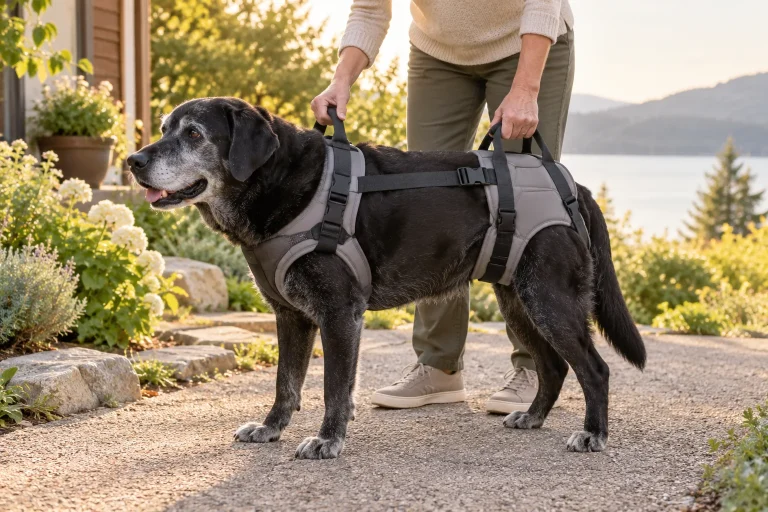
- Who supports the dog, and where? Ask staff to demonstrate the approved method and check the fit of any recommended harness or sling.
- What changes the plan? Obtain instructions for a refusal, slip, worsening weakness or pain, and know whom to contact.
- When is the route reviewed? Ask whether clearance depends on a recheck or other assessment, rather than on how eager the dog seems.
Do not position a sling across an incision or adapt straps around a bandage without the team’s direction. Our support-harness guide explains equipment categories; the clinician must choose the appropriate support arrangement for the operation.
Prepare the essential route
Assemble and inspect the equipment before the dog approaches. Choose firm, level ground, allow a straight starting area, and keep the destination clear. The upper support must match the ramp’s instructions. A ramp resting on the bumper may still leave an unacceptable cargo-floor lip; photographs of the contact point help the team assess that detail.
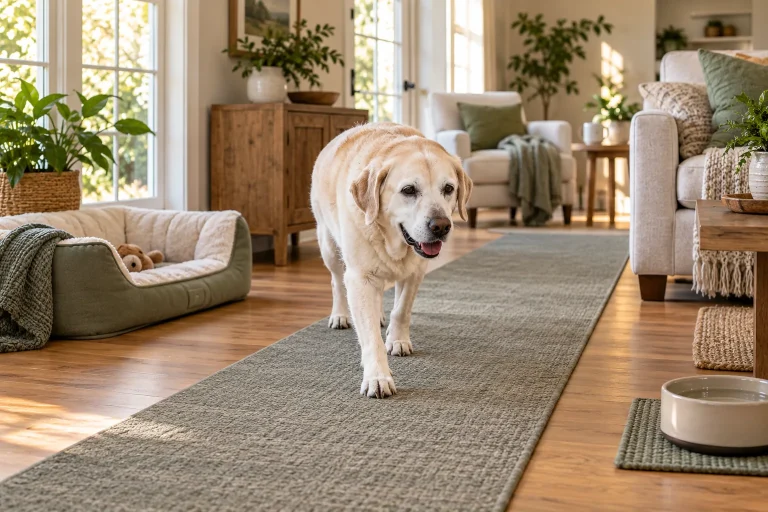
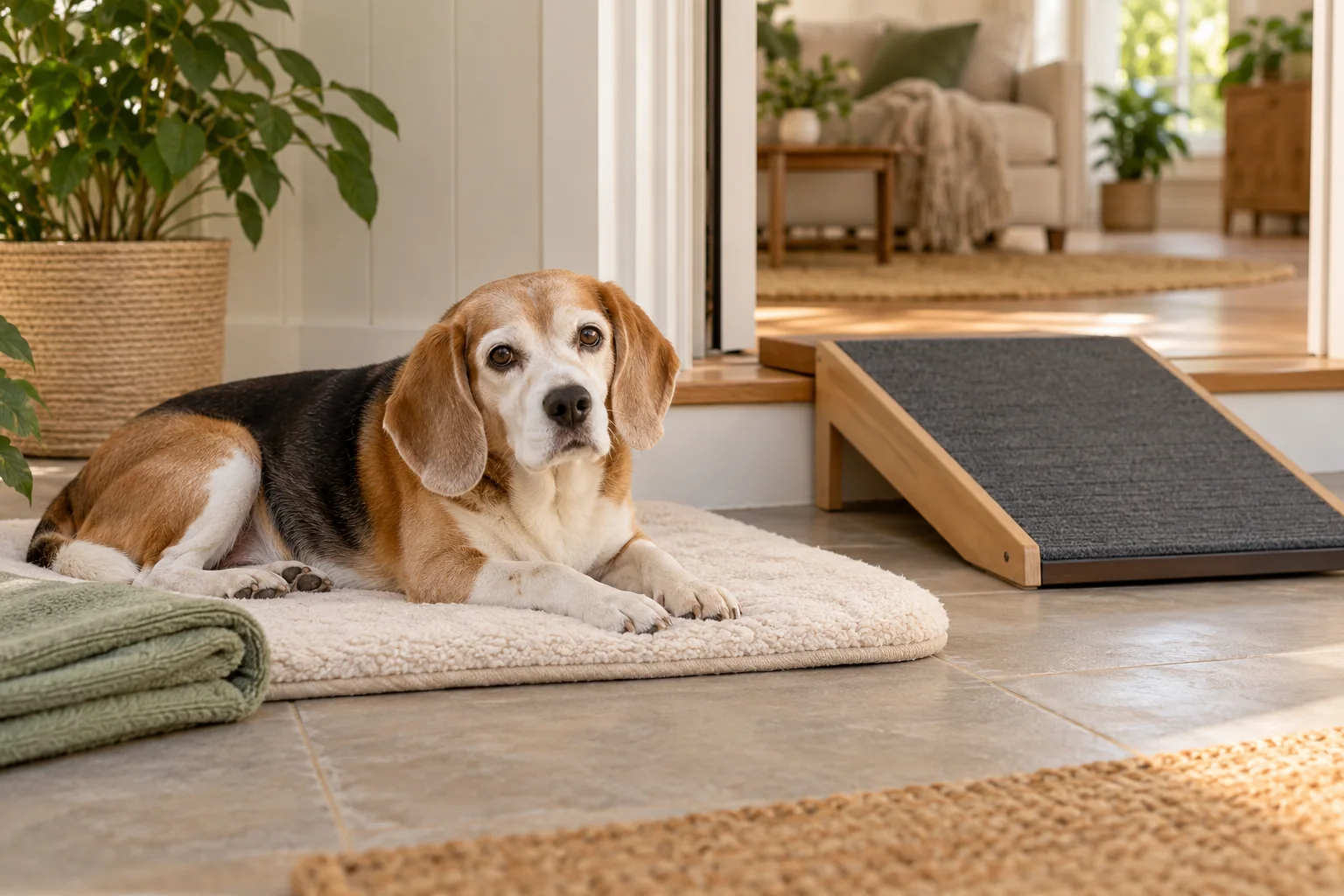
For vehicle measurements and parking considerations, use our SUV and truck ramp guide. At home, review flooring, barriers and rest-area access. A recovery area on one level can remove trips that would otherwise need equipment. A ramp to a sofa or bed does not override instructions to prevent furniture access.
If surgery is planned, ask whether there is time for suitable familiarization beforehand. After surgery, any practice must remain within the discharge instructions; ordinary ramp-training exercises are not automatically appropriate. Do not add repeated crossings as rehabilitation unless the treating team prescribes them.
Review the plan when circumstances change
Follow the activity limits even when your dog appears enthusiastic. If the route no longer works, stop using it and contact the surgical team for an alternative. Do not lower difficulty by adding loose blocks, increase traction with an unapproved covering, or change prescribed support without advice.
A different vehicle, a wet approach, an altered bandage or a change in walking ability can invalidate an earlier arrangement. Keep a brief record of necessary transfers and any difficulty to discuss at follow-up. The purpose of the record is to inform care, not to set a home exercise target.
Frequently asked questions
Can my dog use a ramp immediately after TPLO surgery?
Only if the operating team specifically permits that route and explains the required assistance. Do not infer clearance from the ability to stand or from general advice to avoid jumping.
Is a ramp automatically better than carrying after spinal surgery?
No. The appropriate transfer depends on neurological function, restrictions, dog size and available assistance. Ask the surgical team to choose and demonstrate the method; a product comparison cannot decide it.
What angle is safe during recovery?
There is no universal postoperative angle. Provide the team with the measured rise, usable length, landing transition and support plan. A geometry calculation cannot establish medical clearance.
Can I use ramp crossings as rehabilitation?
Only when the treating team includes them in the prescribed program. Essential access and therapeutic exercise are different decisions. Do not add repetitions or progress the incline on your own.
Sources and verification
- ACVS: Cranial Cruciate Ligament Disease and Fractured Limbs — restrictions and individualized surgical aftercare.
- Cornell: Intervertebral Disc Disease and ACVS: Intervertebral Disc Disease — postoperative rest and controlled care.
- PetSafe XL, Compact, Folding Ramp and telescoping support — product specifications and stated limits.
- WeatherTech PetRamp and Pet Gear Extra Wide supertraX Tri-Fold — manufacturer details and the latter’s carrying-weight discrepancy.
About the author
Grace Wilder
Grace Wilder writes about senior-dog mobility and everyday comfort for PawRampGuide. She covers dog ramps, support harnesses, orthopedic beds, and practical home adjustments, focusing on product fit, ease of use, and clear comparisons. Her goal is to help owners make thoughtful choices that support their aging dogs’ daily routines. Her articles provide general information, with individual health and mobility decisions guided by a veterinarian.