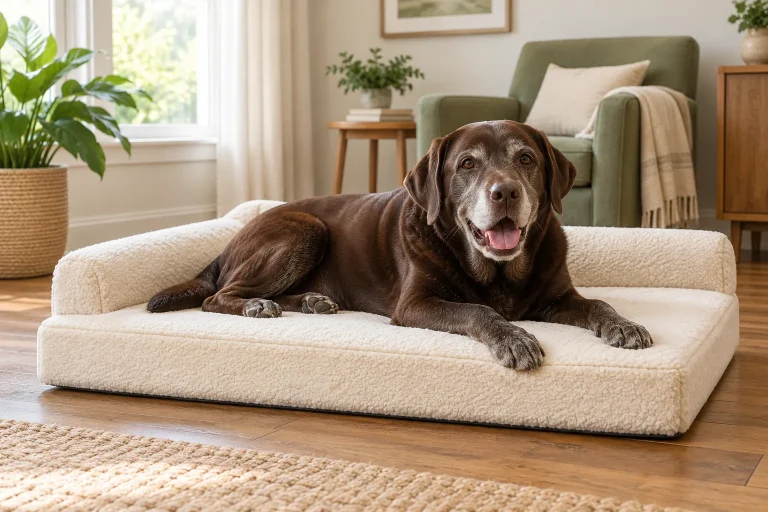
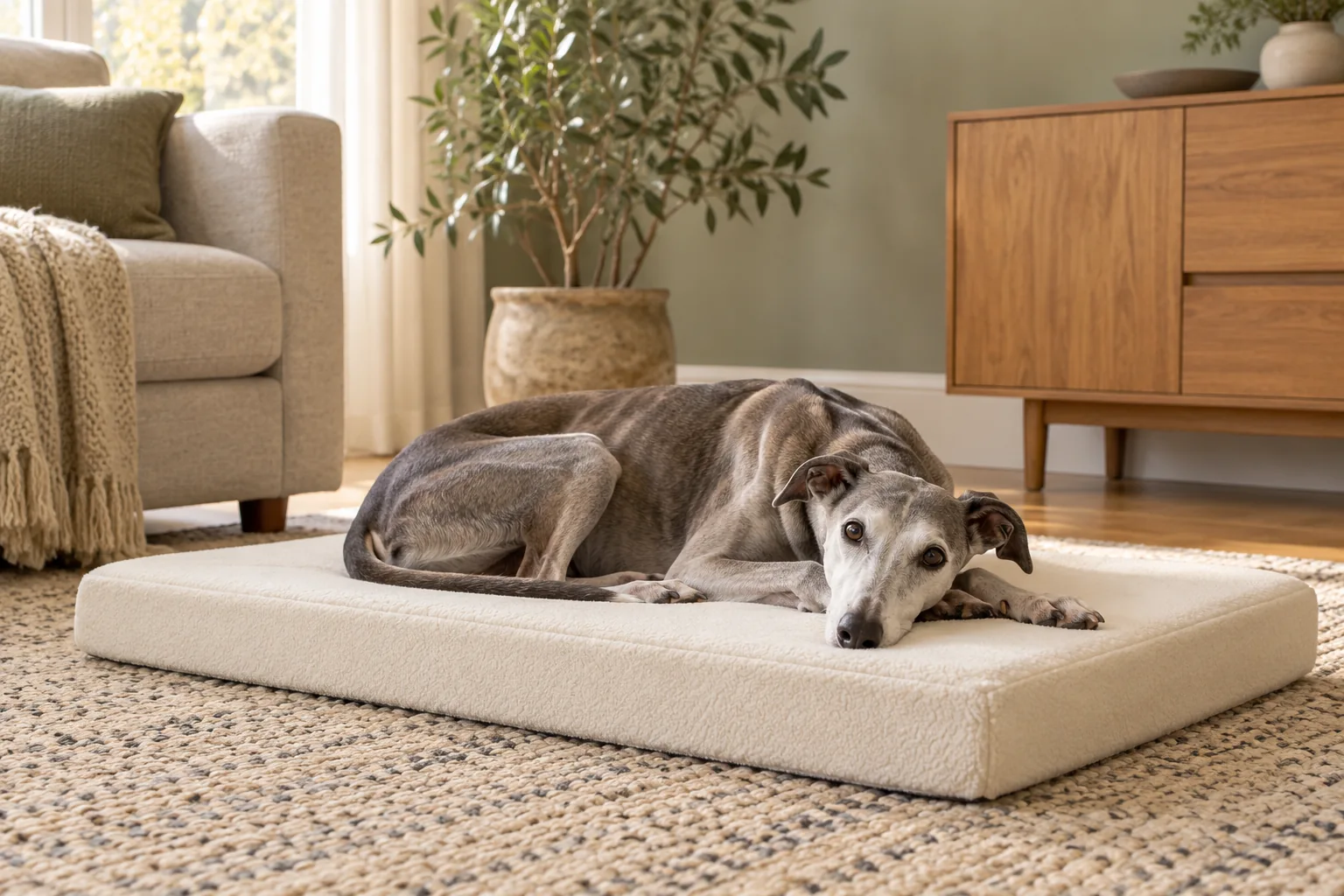
The best low-profile orthopedic dog beds combine an entry your dog can negotiate with enough room and support for rest. For this guide, “low-profile” means an open mattress with a manufacturer-listed height of four inches or less in the specific sizes discussed. That is our comparison rule, not a veterinary standard or a promise that a four-inch step suits every dog.
We compare Bedsure Memory Foam, selected FurHaven Deluxe Mattress sizes, K9 Ballistics in Small only, Dogbed4less’s four-inch pad and Brindle’s Waterproof Designer bed. Some larger variants of these families exceed the limit, so the size and filling selection are part of each recommendation. A seven-inch mattress is outside this shortlist even if its marketing describes easy access.
Five lower-entry beds to compare
| Product | Reason to compare | Manufacturer-stated details | Check carefully |
|---|---|---|---|
| Bedsure Orthopedic Memory Foam Dog Bed | Three- to 3.5-inch open mat | Dual-layer foam · 3–3.5 in listed heights · washable cover | Verify size, foam type and loaded support; not for destructive chewers. |
| FurHaven Ultra Plush Deluxe Mattress — Convolute Orthopedic Foam | Open mattress in selected lower sizes | Medium 30 × 20 × 3 in · Large 36 × 27 × 3 in · Jumbo 40 × 32 × 4 in | Choose Convolute Orthopedic Foam; five-inch Jumbo Plus is excluded from this shortlist. |
| K9 Ballistics Tough Ripstop Rectangle Orthopedic Bed — Small | Firm three-inch mattress for small dogs | Small only: 3 in high · solid foam · removable cover and liner · confirm footprint directly | Small footprints conflict across manufacturer sections; confirm before ordering. Other sizes are five inches; not chew-proof. |
| Dogbed4less Orthopedic Premium Memory Foam Pad | Larger sleeping areas at four inches | 4 in solid gel-infused memory foam · seven sizes · internal liner and outer cover | Confirm size and cover fabric; four inches may still be too high for an individual dog. |
| Brindle Waterproof Designer Memory Foam Pet Bed | Layered open mattress with inner protection | 4 in total: 2 in memory foam + 2 in support foam · 22 × 16 / 34 × 22 / 46 × 28 in | Outer cover is washable; foam is not. Distinguish from shredded-foam Brindle beds. |
Specifications checked October 17, 2026. Fit labels are editorial judgments, not hands-on test awards. Swipe or scroll to view every column.
These are unloaded manufacturer measurements. We have not measured how far the foam compresses beneath different dogs. The word “orthopedic” and a material certification do not establish that a bed treats arthritis or meets your individual dog’s support needs.
How we selected them
We checked manufacturer product information on October 17, 2026, including Petwise’s official FurHaven size chart. We compared stated height, open access, foam type, sleeping dimensions and cover care. This is a research-based comparison, without pressure-mapping tests, durability trials, hands-on dog testing or a systematic owner-review sample.
A bed can support a comfort routine alongside veterinary care. New difficulty settling or rising deserves assessment rather than an assumption that a thicker mattress will fix it. Cornell describes osteoarthritis as a progressive condition managed through a combination of approaches; bedding is not a replacement for that assessment or treatment.
The five-bed shortlist
Bedsure Orthopedic Memory Foam Dog Bed
Bedsure’s Orthopedic Memory Foam Dog Bed is an open, dual-layer mat with a washable zippered cover and a non-slip bottom. The manufacturer lists 24-by-16, 29-by-18, 35-by-22 and 36-by-27-inch versions at three inches thick; the 41-by-29 and 44-by-32-inch versions are 3.5 inches thick.
That size range is useful when you want a lower perimeter without choosing a tiny sleeping area. Measure the dog’s stretched posture rather than matching a weight label. Confirm this memory-foam model: Bedsure sells several beds with similar orthopedic wording, and another model’s fill or dimensions do not transfer here.
Compare the actual base on your flooring after unpacking. A non-slip description does not guarantee stability on every floor. The brand advises against this model for dogs who chew; remove it if the cover becomes damaged and foam accessible.
- Three- to 3.5-inch listed height.
- Several open sleeping-area sizes.
- Individual loaded support remains untested here.
- Not intended for chewing behavior.
Manufacturer source; no hands-on test claim. Verify the exact model and current instructions.
FurHaven Ultra Plush Deluxe Mattress — Convolute Orthopedic Foam
For this shortlist, choose the FurHaven Ultra Plush Deluxe Mattress with Convolute Orthopedic Foam. The official chart lists Medium at 30 by 20 by three inches, Large at 36 by 27 by three inches, and Jumbo at 40 by 32 by four inches. Jumbo Plus is five inches high and falls outside our low-profile rule.
The open mattress provides several entry directions, and the removable cover is machine washable. The product family also includes solid foam, memory-top, gel-top and fiber-filled versions. Keep the selected filling visible in your order; a family photograph is not confirmation of the foam you will receive.
Compare the convoluted surface with your dog’s observed ability to reposition and stand. We cannot infer compressed firmness from an egg-crate photograph. A protective liner is offered separately, so check what is included rather than assuming the plush outer cover protects the foam from accidents.
- Three-inch Medium and Large variants.
- Open layout with removable cover.
- Height and core vary across the family.
- Do not count Jumbo Plus as low-profile.
Manufacturer source; no hands-on test claim. Verify the exact model and current instructions.
K9 Ballistics Tough Ripstop Rectangle Orthopedic Bed — Small
The K9 Ballistics Tough Ripstop Rectangle Orthopedic Bed qualifies here in Small only, at a manufacturer-listed three-inch height. Its product description and size guide publish conflicting Small footprints, so confirm the current sleeping dimensions directly before ordering. Medium and all larger listed sizes are five inches high. The maker describes a firm solid polyurethane foam mattress, removable liner and removable ripstop cover.
This is an option for a genuinely small sleeper whose full resting posture fits those dimensions. Do not buy the Small merely to obtain a lower entry for a larger dog. The manufacturer’s under-30-pound size suggestion is a starting point, while the dog’s actual sleeping footprint determines whether there is room.
The cover is aimed at everyday wear and scratching, with machine washing in cold water and air drying specified. It is not a solution for an aggressive chewer. Ask about replacement covers and liner care if frequent accidents are part of your routine.
- Three-inch firm mattress for small dogs.
- Separately removable cover and liner.
- Only Small meets this guide’s height limit.
- Not chew-proof; cover needs air drying.
Manufacturer source; no hands-on test claim. Verify the exact model and current instructions.
Dogbed4less Orthopedic Premium Memory Foam Pad
Dogbed4less lists its Orthopedic Premium Memory Foam Pad at four inches thick across seven sizes. They range from 35 by 20 inches to 55 by 47 inches, with several intermediate rectangles and crate-oriented dimensions. The construction is a single gel-infused memory-foam pad, supplied with an internal waterproof zippered cover and an external cover.
Compare it when you need a larger open sleeping area while keeping the listed edge at four inches. The separate layers make it important to identify which part needs cleaning. The brand describes the outer cover as machine washable and dryable; that does not authorize putting the foam in the washer.
Different outer fabrics are offered. Confirm the selected material, care label and fit before ordering a spare. We have not tested the cooling effect, compression or stability under an individual dog, so those marketing descriptions do not settle the fit decision.
- Four-inch height across larger footprints.
- Included internal liner and external cover.
- Four inches can still be an obstacle.
- Fabric and size options require careful selection.
Manufacturer source; no hands-on test claim. Verify the exact model and current instructions.
Brindle Waterproof Designer Memory Foam Pet Bed
Brindle’s Waterproof Designer Memory Foam Pet Bed uses a two-inch memory-foam layer over two inches of support foam. Published sleeping sizes are 22 by 16, 34 by 22 and 46 by 28 inches. The maker describes a removable washable cover, a non-skid bottom and a waterproof inner layer around the foam.
Compare it when a four-inch open bed and separate outer-cover cleaning suit the household. Distinguish this solid layered design from Brindle’s shredded-foam beds; the construction and thickness are different. Confirm the exact seller size and model through the manufacturer link before buying.
The outer cover itself is not waterproof, and the foam filling is not washable. Keep the inner protection intact and follow the supplied care directions. The bed is not chew-proof. Its lowest size has a small footprint, so measure stretched sleeping positions as well as a curled-up pose.
- Explicit two-plus-two-inch layered construction.
- Separate inner protection and washable cover.
- Four-inch entry in every listed size.
- Foam cannot be machine washed.
Manufacturer source; no hands-on test claim. Verify the exact model and current instructions.
Measure access and sleeping room separately
Begin with the route onto the bed. Observe how high your dog can comfortably step without encouraging a difficult movement for the sake of measuring. Discuss limitations with the veterinary team. Measure the lowest entry edge on the intended model; the overall height of a bolster is a different number.
Next, measure the area your dog occupies across several natural sleeping positions. Include the head, extended legs and room to change position. A lower mattress that leaves half the dog hanging off its edge has not solved the resting problem. This is especially relevant to the three-inch K9 Small, whose footprint cannot be enlarged while keeping that model’s height.
Mark the bed’s floor outline and inspect the exit. The dog should not have to rise, pivot sharply around a table and immediately cross a slippery tile. Our home adaptations checklist considers the whole resting-to-walking route.
Low entry and adequate support are different goals
A thinner mattress reduces the unloaded edge height, but thickness alone cannot tell you how it behaves under a dog’s shoulders or hips. Memory foam, solid support foam and convoluted foam describe different structures. Neither the softest description nor the highest density establishes the right feel for every dog.
When evaluating a new bed, look for practical movement: can the dog enter, turn, settle and get up? Does the cover bunch, the bed move, or the dog repeatedly return to another resting place? Record what you observe rather than treating a single long nap as a product test. For broader layouts, compare our senior-dog orthopedic bed guide.
Plan the cleaning cycle before the first accident
Identify the outer cover, liner and foam as separate components. A washable cover does not mean washable foam; water resistance does not mean every seam tolerates standing liquid. Check both the included protection and its replacement options, particularly if your dog has accidents.
Read drying instructions before deciding that a model fits your household. An air-dry cover needs time and a place to dry fully. A correctly fitting spare cover or second accessible resting spot may be useful during washing. Avoid adding loosely folded bedding that changes the entry height or moves beneath the dog.
Inspect zips, seams and the underside after cleaning. Remove damaged bedding if filling becomes accessible. Ripstop, durable and waterproof describe particular features; none is permission to leave a dog ingesting foam or fabric.
When the lowest bed still does not work
If a dog cannot manage a three-inch entry, keep looking at the access plan with your veterinary team. Do not stack loose cushions or improvise a tiny step that adds another moving surface. The problem may require a different resting arrangement or assistance when rising.
For dogs who still use elevated furniture, our indoor ramp comparison examines the complete transition. The senior mobility buying guide helps prioritize beds, traction and other support around the routines that matter most.
Frequently asked questions
How low is a low-profile orthopedic dog bed?
There is no universal cutoff used here as a medical standard. This guide includes open mattresses no taller than four inches in the specified variants. Your dog may need a lower entry, and the usable sleeping area still has to fit.
Is a three-inch bed better than a four-inch bed?
Only when the full combination of access, support, space and stability suits the dog better. One inch of lower entry can matter, but it does not establish how the foam supports the dog or behaves during rising.
Can I choose a smaller size to get a lower height?
Only if that size actually fits the dog’s sleeping positions. K9 Ballistics Small is three inches while larger sizes are five inches. A larger dog needing low access should compare a different product rather than lose necessary sleeping room.
Will an orthopedic bed relieve my dog’s arthritis?
A suitable resting surface can be part of a comfort plan, but no model here is presented as treatment or a cure. Persistent pain, restlessness or difficulty standing calls for veterinary assessment and an individual management plan.
Sources and verification
- Linked manufacturer pages support product descriptions checked October 17, 2026.
- Petwise/FurHaven: official Deluxe Mattress filling options and size chart.
- Cornell University: osteoarthritis and multimodal veterinary management.
About the author
Grace Wilder
Grace Wilder writes about senior-dog mobility and everyday comfort for PawRampGuide. She covers dog ramps, support harnesses, orthopedic beds, and practical home adjustments, focusing on product fit, ease of use, and clear comparisons. Her goal is to help owners make thoughtful choices that support their aging dogs’ daily routines. Her articles provide general information, with individual health and mobility decisions guided by a veterinarian.