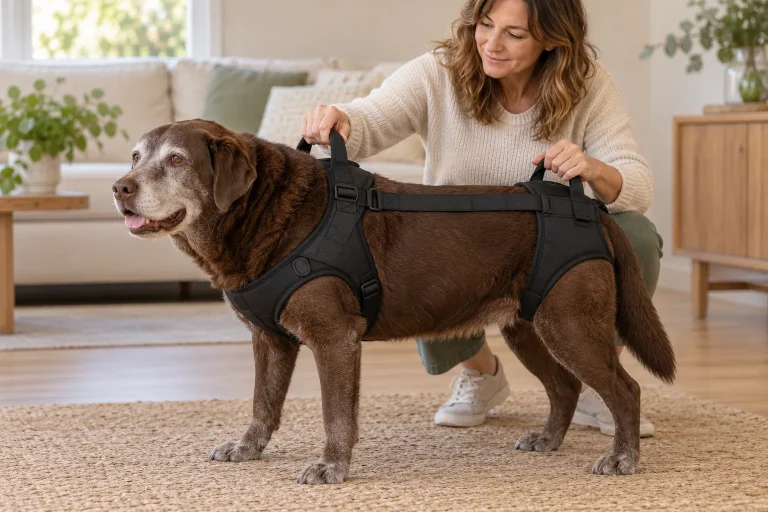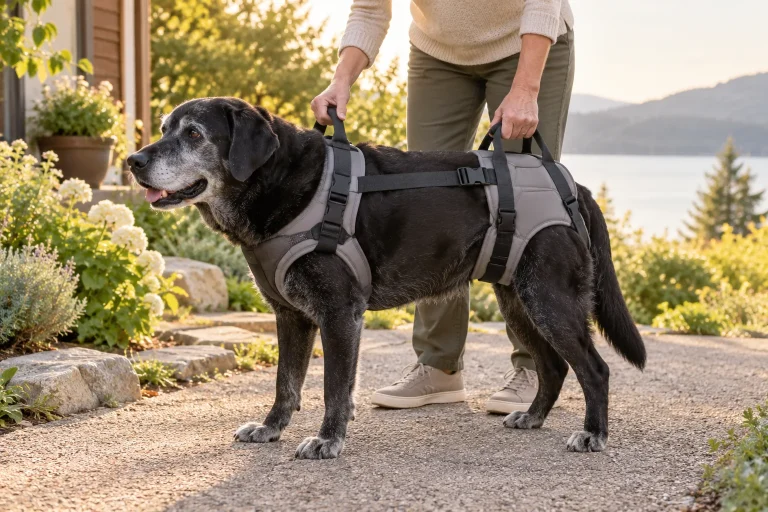
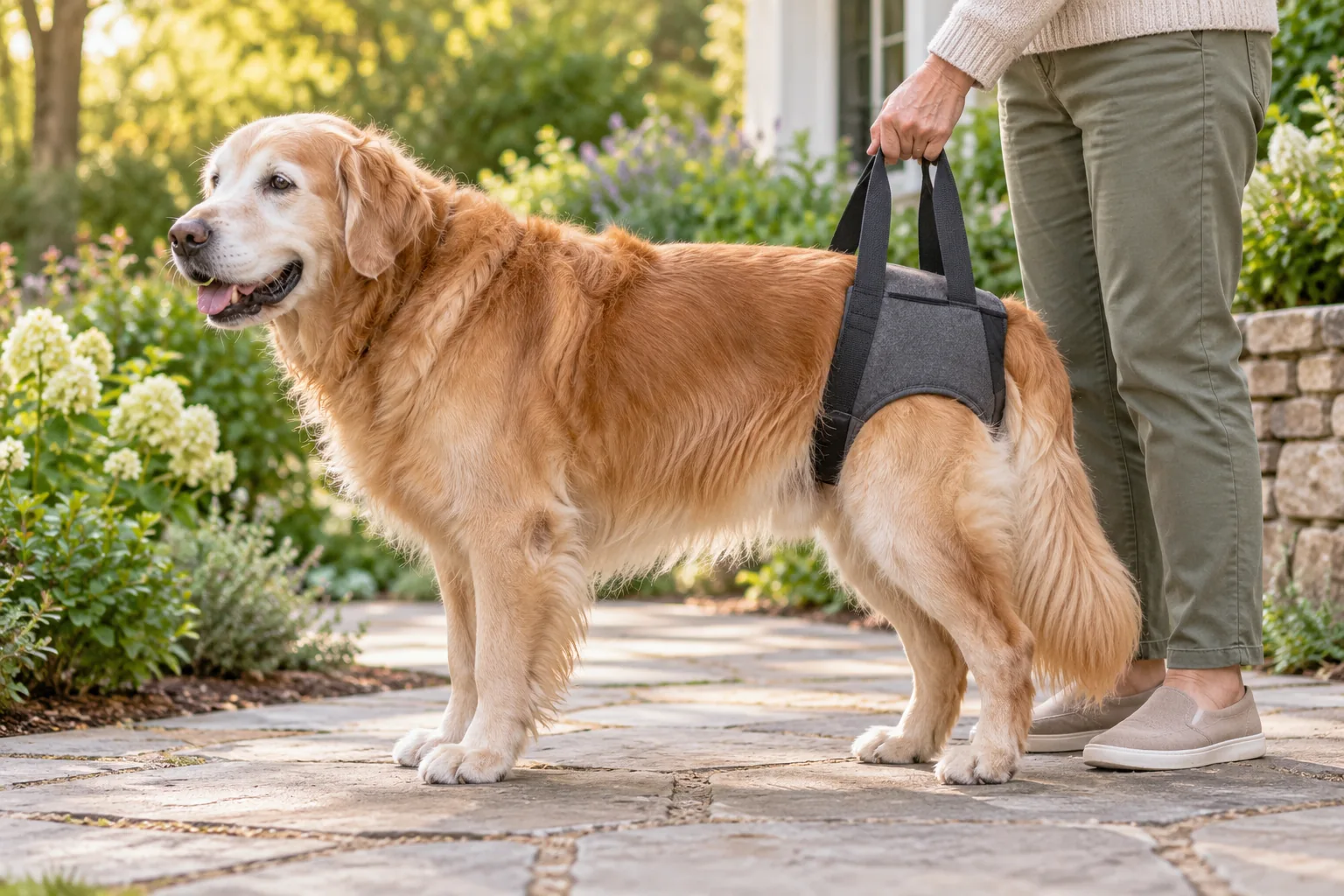
The best rear support harnesses for dogs with weak hind legs make a specific daily task manageable: helping a dog rise, supporting the hindquarters during an approved short walk, or getting outside for a toilet break. The right choice depends on the dog’s diagnosis, front-leg strength, body shape and the caregiver’s ability to provide the prescribed help.
Our five-product shortlist compares two different approaches: broad support beneath the body and fitted support around the hindquarters. GingerLead, PetSafe CareLift Rear, Walkin’ Warrior Rear, Walkin’ Pets EZ Lift and the Original Walkabout Back End Harness each offer a different fitting or handling format. These are research-based comparisons of current manufacturer information, with no hands-on testing or purchaser-review scoring.
Five rear-support options at a glance
| Product | Reason to compare | Manufacturer-stated details | Check carefully |
|---|---|---|---|
| GingerLead Support & Rehabilitation Sling | Pad-style assistance for short supervised tasks | Support pad · adjustable handles · attached leash | Choose pad configuration carefully; never lift with its leash attached to a collar. |
| PetSafe CareLift Rear Support Harness | Structured rear-only assistance | Belly band · rear-leg straps · rear lifting handle | Rear section is not the full system; remove when not in use. |
| Walkin’ Warrior Rear Harness | Rear support with specified cart compatibility | Rear-leg openings · adjustable handles · thigh-based sizing | Supports the hindquarters only; verify exact rear-wheelchair compatibility and remove for rest. |
| Walkin’ Pets EZ Lift | Hand-held support alternative | Closed-cell foam support · adjustable handle · Small/Standard variants | Confirm conflicting size wording and selected-size availability directly. |
| Original Walkabout Back End Harness | Fitted hindquarter aid with handle-length options | Abdomen-and-thigh sizing · set-length handles | Discuss caregiver reach before ordering; custom handle length may be needed. |
Specifications checked October 17, 2026. Fit labels are editorial judgments, not hands-on test awards. Swipe or scroll to view every column.
When rear support is the right category
Rear assistance addresses the back end. It does not automatically provide the chest support, balance or control needed when the front legs also buckle. Describe the whole movement to the veterinary team: whether the dog struggles to rise, takes a few supported steps, drags a foot, or becomes tired before reaching the garden. Those observations are more useful than asking for the strongest sling.
A belly sling usually has a pad placed beneath part of the torso, with handles above. A fitted rear harness uses shaped panels or leg openings around the hindquarters. Neither shape is universally better. A dog’s permitted movements, sensitive areas and toileting clearance can make one easier to fit than another. If support is required at both ends, compare our full-body harness guide and ask which system matches the handling plan.
Be precise about what “lift” means. Supporting part of a dog’s weight while the feet remain on the ground differs from carrying the entire dog. Do not turn a rear-support product into a suspension device. A manufacturer’s list of possible activities is also not clearance for your dog to use stairs after surgery.
Our rear-support shortlist
GingerLead Support & Rehabilitation Sling
GingerLead is worth comparing for brief assisted walks when a pad-and-handle design suits the veterinary plan. It combines a support sling with adjustable handles and an attached leash. The range has several pad configurations, so choose from the actual sizing instructions rather than assuming one “large” version suits every large dog.
The leash connection is a consequential detail. GingerLead says never to lift a dog entirely off the ground while its leash is attached to a collar; for the Mini, it recommends connecting to a chest harness to avoid accidental neck lifting. A separate chest harness is not included. Treat that connection as part of the setup to review with the clinic.
Its appeal is a relatively direct routine for short, supervised assistance. The tradeoff is reproducing correct pad placement and balanced handle adjustment each time. Check that the pad stays where intended during the actual toilet route.
- Several pad shapes and sizes.
- Adjustable handles with integrated leash connection.
- Placement must suit the individual dog.
- Not a full-body carrying system.
Manufacturer source; no hands-on test claim. Verify the exact model and current instructions.
PetSafe CareLift Rear Support Harness
PetSafe CareLift Rear is a dedicated rear section with a belly band, rear-leg straps and a lifting handle. It belongs on this list separately from the complete CareLift system. Check the exact package name before ordering; a full-body photograph or a replacement-section listing does not establish what is included.
PetSafe’s setup instructions explain the protection shield and toileting adjustments. They also tell owners to check fit frequently for rubbing or pinching and to remove the harness when it is not in use. This makes it a candidate for households prepared to fit and remove a structured aid for supported activities.
The manufacturer describes connecting a compatible front section if full-body support is needed. Ask PetSafe about the correct front component instead of improvising a connection to an unrelated walking harness. That option is useful to compare when needs may change, but buying the rear section alone does not provide front support.
- Dedicated rear handle and leg straps.
- Published setup and toileting instructions.
- Requires removal between uses.
- Complete front-and-rear system is a separate purchase decision.
Manufacturer source; no hands-on test claim. Verify the exact model and current instructions.
Walkin’ Warrior Rear Harness
Walkin’ Warrior Rear uses rear-leg openings and adjustable handles. Its sizing starts with the circumference of the upper thigh. This is a useful comparison if a shaped rear harness fits the prescribed support position better than a broad torso pad.
The manufacturer identifies compatibility with specified Walkin’ Wheels rear wheelchairs. Confirm the exact cart size and attachment arrangement if that is part of your purchase. A compatible harness can simplify a routine, but the brand name alone does not establish compatibility with every wheelchair.
Warrior Rear is intended for the hindquarters, and the manufacturer directs buyers needing complete front-and-rear lifting to Help ’Em Up. Its instructions also say to remove the harness when the dog rests. Compare the process of putting the legs through the openings with the movements your dog can comfortably tolerate; do not force painful joints into position to make a harness fit.
- Adjustable handle height.
- Specified rear-wheelchair compatibility.
- Requires accurate thigh sizing.
- Rear support only; remove for rest.
Manufacturer source; no hands-on test claim. Verify the exact model and current instructions.
Walkin’ Pets EZ Lift
Walkin’ Pets EZ Lift offers a different construction: closed-cell foam around a flexible support system, with an adjustable handle. The manufacturer describes front or rear assistance. Compare it as a hand-held support option when you and the veterinary team want an alternative to a fabric sling or fitted rear panel.
Check sizing directly before purchase. The current selectors identify Small for 20–40 pounds and Standard for 41–100 pounds, while another paragraph uses broader wording. The page also shows an unavailable-variant notice, so confirm the selected version rather than treating the presence of an add-to-cart button as a stock guarantee.
Ask the clinic to show precisely where this design should contact the dog. Its foam construction does not establish suitability over an incision or sensitive tissue. Its practical advantage is a distinct support shape; the limiting question is whether that shape and your handle position work for the intended route.
- Alternative to a fabric support pad.
- Adjustable handler position.
- Confirm size wording and stock.
- Placement needs individual assessment.
Manufacturer source; no hands-on test claim. Verify the exact model and current instructions.
Original Walkabout Back End Harness
The Original Walkabout Back End Harness is a fitted hindquarter aid sized using abdomen and upper-thigh measurements. The brand defines the abdomen measurement directly in front of the rear legs and the thigh measurement where the leg meets the body. Using both helps distinguish a broad waist from a large thigh.
Its handles come in set lengths that vary by size, with longer handles available by request. That is an important difference from continuously adjustable handles. Before ordering, explain the dog’s height and the caregiver’s comfortable standing position so the handle arrangement can be checked.
Walkabout describes daytime wear and toileting clearance, but an individual plan still needs skin checks and appropriate removal. Compare this design when repeat access to a fitted rear aid matters. If the dog has an amputation or unusual proportions, discuss the brand’s specific options rather than ordering an ordinary two-leg version and altering it at home.
- Abdomen-and-thigh sizing.
- Manufacturer offers handle-length options.
- Standard handles have set lengths.
- Fit around leg openings needs close attention.
Manufacturer source; no hands-on test claim. Verify the exact model and current instructions.
Measure for the product you are actually buying
Keep a short measurement sheet with the date, current weight and units. Add only measurements requested by each shortlisted brand. Photograph or save its diagram beside the numbers. “Waist” can mean a different location from one chart to another, and a remembered measurement from an old walking harness may be irrelevant.
Use a soft tape without compressing the coat. If standing, lifting a leg or reaching under the body causes discomfort, ask the clinic to help. Repeatedly repositioning an uncomfortable dog to complete an online form defeats the purpose of careful equipment selection. Send the manufacturer the measurements and a description of the task if the dog falls between sizes.
Read return conditions before ordering custom modifications. If fit is poor, seek assistance rather than tightening every strap or using an improvised knot.
Check the movement as well as the standing fit
A harness can fit when standing and migrate during a turn. At the fitting appointment, show the real task and ask which contact points to inspect and adjustments to use.
Watch for bunching, twisting, dampness and changes in the dog’s willingness to move. Report discomfort or skin changes to the veterinary team and stop using a poorly fitting aid until the setup is reviewed. Do not assume extra padding will correct a pressure point created by the wrong size or support position.
Plan the toilet trip from beginning to end
Plan where the aid is kept, who opens the door and where the dog can pause. Set out cleanup supplies and a place for the harness afterward.
Check clearance on the actual dog, including any manufacturer-directed change to a band or shield. Products advertised for male and female dogs still need individual fitting. Keep contaminated fabric away from the skin and follow the product’s cleaning instructions. The household needs a usable aid while a washed one dries, so discuss a suitable backup with the clinic if accidents are frequent.
Reduce obstacles on the route before adding more support equipment. Our home modifications checklist covers access and traction throughout the house. An absorbent mat should lie flat and stay in place; a loose edge beside the door can complicate an otherwise manageable trip.
Make the caregiver part of the fitting
Discuss every caregiver’s grip, balance and reach with the veterinary team. If someone cannot maintain the demonstrated position, ask for another handling plan.
Have the professional demonstrate the intended support, then watch you repeat it. Ask how much assistance is appropriate and whether the feet should remain weight bearing. A product description cannot set those limits for a dog recovering from surgery or living with neurological disease. Record the demonstration on your phone if the clinic permits it, so everyone can review the same instructions.
Note practical problems such as a hard-to-reach handle or a buckle hidden by coat, then ask for help with those specific issues.
Know when to revisit the choice
Save a brief log of tasks the dog can manage and where help is needed. AAHA’s senior-care guidance encourages owners to share videos of mobility changes with their veterinary team. A short clip of an ordinary movement can make an appointment more informative than a general report that the dog is “slower.” Do not provoke a difficult movement just to film it.
If the front end begins to struggle, the sling shifts repeatedly, or toilet access becomes harder, seek a reassessment. Our broader support-harness comparison explains the categories, while the wheelchair discussion guide helps prepare questions about a cart. There is no fixed timetable requiring every dog to move through the same products.
Frequently asked questions
Which rear harness is best for weak hind legs?
Choose by the prescribed support position, measurements and daily task. A broad sling and a fitted leg-loop harness solve different handling problems. Ask for a fitting demonstration before deciding which format suits your dog.
Can I use the rear half of Help ’Em Up on its own?
No. Help ’Em Up says its rear Hip Lift must connect to its front section to remain in place. It is a complete-system comparison, rather than a standalone rear-harness choice.
Can a rear support harness stay on during sleep?
Do not assume so. PetSafe instructs removal when CareLift Rear is not in use, and Warrior Rear should be removed for rest. Follow the selected manufacturer’s instructions and your dog’s veterinary care plan.
Is a towel an adequate replacement for a dog sling?
Ask the veterinary team whether temporary towel assistance is appropriate and have the placement demonstrated. Its suitability depends on the dog’s condition and task; an improvised support is not equivalent to every fitted device.
Sources and verification
Manufacturer information checked October 17, 2026. Products were selected for documented rear-support functions and different fitting formats. We did not perform hands-on trials, verify Amazon listings or conduct a systematic purchaser-review analysis.
- GingerLead: support-sling instructions and collar restriction; current product range.
- PetSafe: CareLift Rear setup, use and removal instructions.
- Walkin’ Pets: Warrior Rear sizing, compatibility and rest restrictions.
- Walkin’ Pets: EZ Lift construction and current size selectors.
- Walkabout: Original Back End Harness measurements and handles.
- Help ’Em Up: rear-section connection requirement.
- AAHA: assessment and monitoring of senior-pet mobility; emergency warning signs.
About the author
Grace Wilder
Grace Wilder writes about senior-dog mobility and everyday comfort for PawRampGuide. She covers dog ramps, support harnesses, orthopedic beds, and practical home adjustments, focusing on product fit, ease of use, and clear comparisons. Her goal is to help owners make thoughtful choices that support their aging dogs’ daily routines. Her articles provide general information, with individual health and mobility decisions guided by a veterinarian.