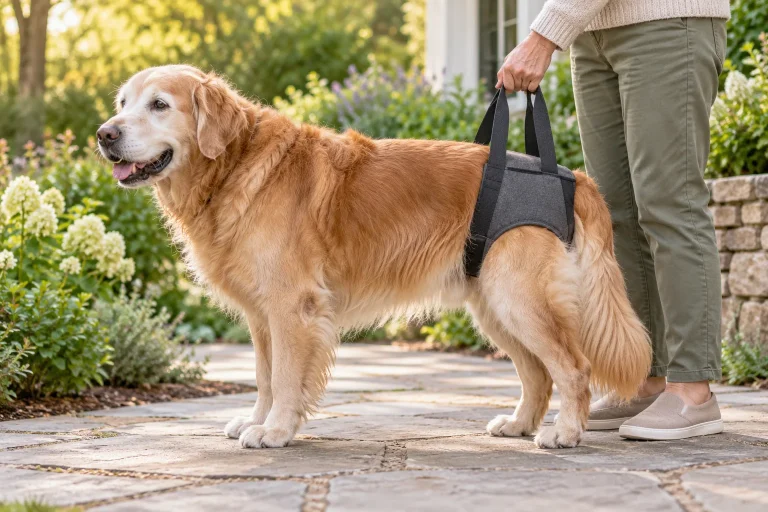
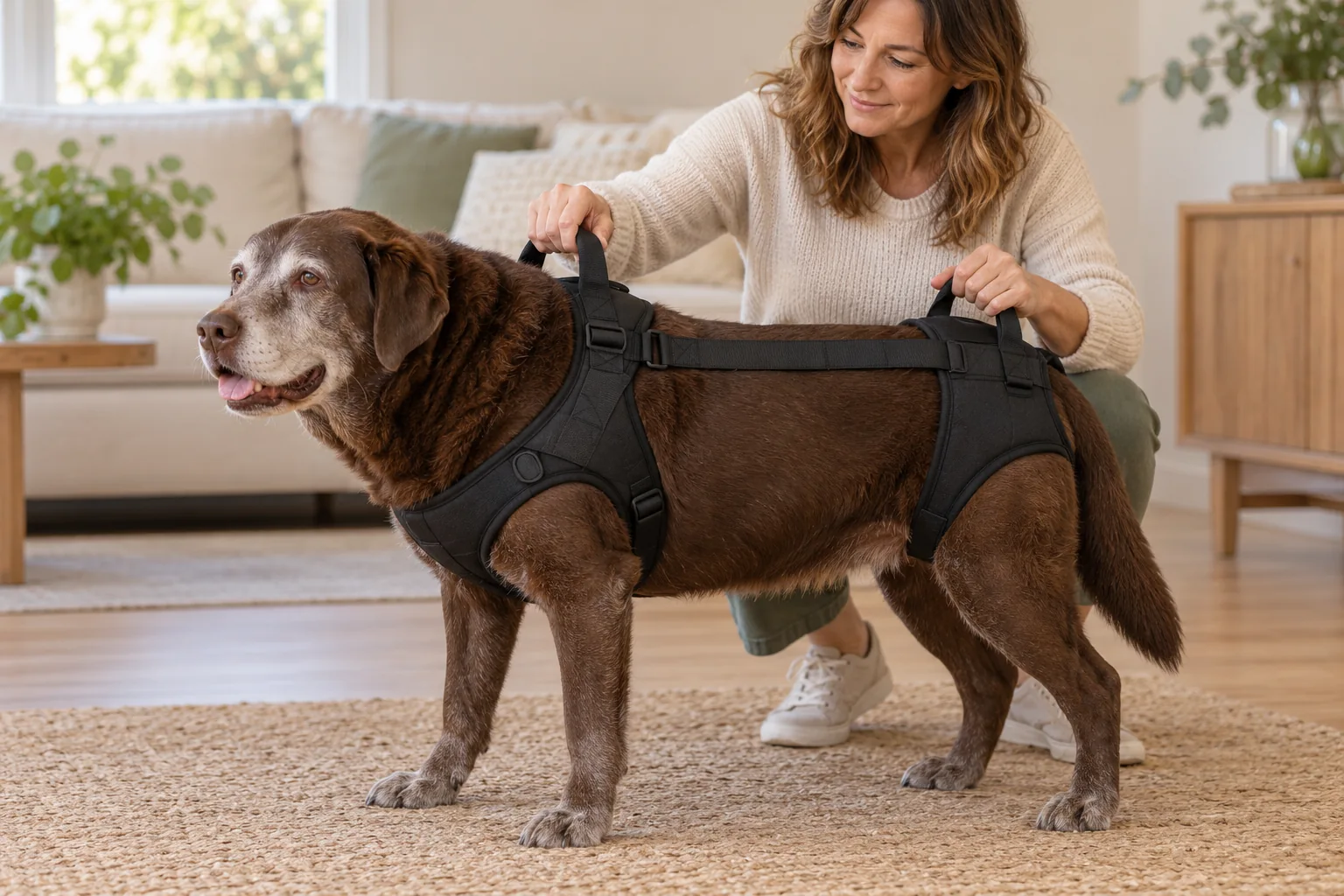
The best full-body lift harnesses for senior dogs support a different task from an ordinary walking harness: helping at both the front and rear, or providing an approved supported transfer. Choose the design after a veterinary assessment and a demonstration with your dog. The presence of a handle does not establish that a product can carry the animal’s entire weight.
Our shortlist includes Help ’Em Up, PetSafe CareLift, the Original Walkabout Combination, Airlift One Combination and Walkabelly Support Lift. The first four use separate front and rear sections; Walkabelly is a torso-wrap support sling and should be evaluated as a different transfer format. These research-based picks reflect manufacturer documentation, with no hands-on testing or review-score ranking.
Five full-body support systems to compare
| Product | Reason to compare | Manufacturer-stated details | Check carefully |
|---|---|---|---|
| Help ’Em Up Harness | Coordinated chest and pelvic support | Two-part lifting system · separate front and rear handles | Rear Hip Lift must connect to the front section; select the correct rear style. |
| PetSafe CareLift Support Harness | Alternative two-part full-body system | Front and rear handles · mesh construction · multi-measurement sizing | Check the full-system package, size chart and supplied lifting accessories. |
| Original Walkabout Front and Rear Combination | Paired support with offered handle lengths | 2.0 mm neoprene · front/rear sizing · optional suspender | Confirm handle lengths and connector; custom modification affects returns. |
| Airlift One Front and Rear Combination | Paired support with adjustable handles | Airprene construction · adjustable handles · separate front/rear sizing | Confirm connecting suspender in the order and assess individual anatomy clearance. |
| Walkabout Walkabelly Support Lift | Wrap-style supported transfer alternative | Neoprene/fleece torso sling · hook-and-loop closure · set-length handles | Different contact pattern from two-part systems; confirm permitted transfer and handle reach. |
Specifications checked October 17, 2026. Fit labels are editorial judgments, not hands-on test awards. Swipe or scroll to view every column.
Full-body support does not define the amount of lifting
“Full-body” describes where assistance is available. It does not mean every dog should be suspended, carried up stairs or moved with one hand. A dog may need help at the chest and pelvis while still using the feet. Another may need a short, carefully planned transfer. The diagnosis and the permitted movement determine the task; the product label cannot do that.
Bring a concrete example to the fitting, including the starting surface, destination and caregiver space. A system can fit the dog but leave the person unable to reach both handles in a narrow hallway.
If assistance is only needed at the hindquarters, compare the simpler formats in our rear-support harness and sling guide. If both ends require help, avoid buying a front walking harness and rear aid separately without confirmation that their combination is intended for the required task.
Our full-body support shortlist
Help ’Em Up Harness
Help ’Em Up combines chest and rear sections, an adjustable connector and separate lifting handles. Its design places support beneath the sternum and pelvis. Compare it when the veterinary team wants coordinated access to both ends rather than a single broad belly pad.
The rear configuration matters. The brand offers Conventional and U-Band Hip Lift options for different anatomy, as well as mixed sizing. Explain any elimination-clearance concern when discussing the fit rather than choosing only from body weight.
There is a firm restriction: the rear Hip Lift must connect to the front section. Help ’Em Up warns that the rear piece can slip off when used alone. This makes it a complete-system choice, even if rear assistance is the main daily use. Its multiple adjustments can accommodate different proportions, but they also create settings that every caregiver needs to understand and reproduce.
- Coordinated chest and pelvic support.
- Rear-style and mixed-size options.
- Rear section cannot be used alone.
- Several fitting adjustments to learn.
Manufacturer source; no hands-on test claim. Verify the exact model and current instructions.
PetSafe CareLift Support Harness
PetSafe CareLift is a front-and-rear support system with handles and a lifting-belt arrangement. The manufacturer supplies a chart covering waist, chest girth and weight. Compare all three measurements rather than selecting a size from the dog’s weight alone.
PetSafe identifies a shoulder strap for the Medium and Large harnesses. Confirm the accessories supplied with your exact version; a rear-only product or replacement front section is not the complete harness. If the strap is important to you, include its intended use in the professional demonstration rather than assuming it permits a one-person carry.
The mesh is machine washable, and the design includes a removable male protection shield. Discuss toileting adjustments and cleaning as part of everyday fit. This is a useful alternative to compare with Help ’Em Up when you want two-point support, but their different pads and strap arrangements are not interchangeable instructions.
- Front and rear support handles.
- Published waist-and-girth chart.
- Check exact package and accessories.
- Requires individual toileting-clearance assessment.
Manufacturer source; no hands-on test claim. Verify the exact model and current instructions.
Original Walkabout Front and Rear Combination
The Original Walkabout Combination uses matched front and back harnesses. The manufacturer describes the pair as a system for assisting pets that have difficulty using all four legs. Its original construction uses 2.0 mm neoprene and handles offered in different lengths.
Walkabout also offers an optional removable suspender to keep the two sections together and prevent the rear section sliding backward. Confirm whether that option belongs in your dog’s setup before ordering; the manufacturer identifies the modification as nonrefundable. If front and rear measurements fall into different sizes, contact the brand for ordering guidance.
Compare the Original when a fitted two-section system and the offered handle arrangement suit the household. Handle length is a purchase decision with this version. Do not assume that selecting a larger dog size produces a better handle position for a tall caregiver.
- Front and rear can be sized to proportions.
- Optional connector between sections.
- Discuss handle length before ordering.
- Custom modification affects returns.
Manufacturer source; no hands-on test claim. Verify the exact model and current instructions.
Airlift One Front and Rear Combination
Airlift One Combination is Walkabout’s distinct front-and-rear system with breathable airprene construction, adjustable handles and more room for male dogs. The manufacturer says its size and function correspond to the Original Walkabout range. Its reason for inclusion is the material and handling configuration, rather than a different size of the same harness.
Adjustable handles are worth comparing when caregivers have different comfortable hand positions. They still need to be set and checked for the person doing the task. Breathable fabric is a construction feature, not a guarantee that prolonged wear suits every dog.
The ordering page requests abdomen, thigh, chest and front-leg measurements and allows separate front and back sizes. It asks buyers to indicate if they want the suspender connecting the sections. Confirm those details with the manufacturer so the delivered system matches the intended support arrangement.
- Adjustable rather than set-length handles.
- Airprene fabric and additional male clearance.
- Several body measurements required.
- Confirm connecting suspender in the order.
Manufacturer source; no hands-on test claim. Verify the exact model and current instructions.
Walkabout Walkabelly Support Lift
Walkabelly Support Lift is a torso-wrap sling, rather than another two-part chest-and-rear harness. The manufacturer describes a neoprene wrap with fleece lining and a hook-and-loop closure, intended for lift assistance and supported movement. It belongs in the comparison when the veterinary team considers a wrap-style transfer aid suitable.
It does not provide separately positioned chest and pelvic handles like the paired systems above. Ask exactly where its panel should contact your dog and which supported transfers are appropriate. Do not infer suitability over an abdominal wound or sensitive area from the fleece lining.
Sizing requests abdomen, chest and body-length measurements. Standard handle lengths vary by size, with custom lengths available by discussion. Compare the complete fitting diagram and caregiver reach before buying. Its practical attraction is a different support format; that difference also means the same handling instructions cannot be copied from a two-piece harness.
- Distinct wrap-style transfer format.
- Manufacturer offers custom handle discussion.
- Different contact pattern from paired systems.
- Standard handles have set lengths.
Manufacturer source; no hands-on test claim. Verify the exact model and current instructions.
Fit the front, rear and connection as a system
Record current weight, units, date and the manufacturer’s requested measurements. Follow its diagram rather than another brand’s definition of “girth.” Ask the clinic for help if measuring is uncomfortable.
Front and rear may need different sizes. Send the requested measurements to the brand and ask about permitted combinations. An oversized rear section is not corrected by tightening the front.
At the fitting, ask the professional to assess the pad positions, leg openings and connector during the prescribed movement. Confirm that straps do not twist or shift into sensitive areas when the dog turns or settles. The connector’s job and adjustment method depend on the product; do not replace it with an unrelated leash or homemade elastic strap.
Keep settings understandable for the household
Save reference photographs of the approved fit, connector and pad orientation beside the instructions. They help caregivers remember the setup; check the actual dog each time.
Recheck after cleaning or a change in body condition. Previous strap settings do not prove today’s fit. If a section consistently migrates, seek reassessment.
Build a realistic caregiver and transfer plan
Describe the people who will provide assistance, including their ability to grip, balance and maintain the demonstrated position. A harness does not reduce a large dog to a small lifting load. Having a shoulder accessory also does not establish that the caregiver can safely complete every transfer alone.
Ask the veterinary team to show the actual task, then watch each regular caregiver practice it. Clarify the permitted support points, how much assistance is intended and whether a second person is needed. Do not choose a lifting technique from a product image. Restrictions after surgery can differ substantially from a general mobility routine.
Plan the destination before starting. The resting surface should be ready, doors accessible and the route clear. If a transfer requires letting go to move furniture or reach a latch, change the arrangement first. Keep pets and household traffic out of the working space while the routine is being learned.
Keep contact details in the care notes for unexpected changes. If the normal route becomes impossible, seek another plan instead of attempting a heavier lift.
Separate assisted activity from rest and cleaning
Ask for a wear-and-removal schedule for the selected product and dog. A harness described as suitable for longer wear still needs attention to skin, moisture and fit. Check the areas identified by the clinic, particularly when the setup is new. Remove an unsuitable or uncomfortable aid and seek guidance rather than covering a rubbing point and continuing.
Know which toileting adjustments are approved and which sections stay connected. If urination repeatedly wets a pad, review the fit; washable fabric does not solve prolonged dampness.
Follow the washing and drying instructions, then inspect handles, seams and buckles. Plan access to a suitable clean aid during drying, and keep both sections together.
Match the equipment to the surroundings
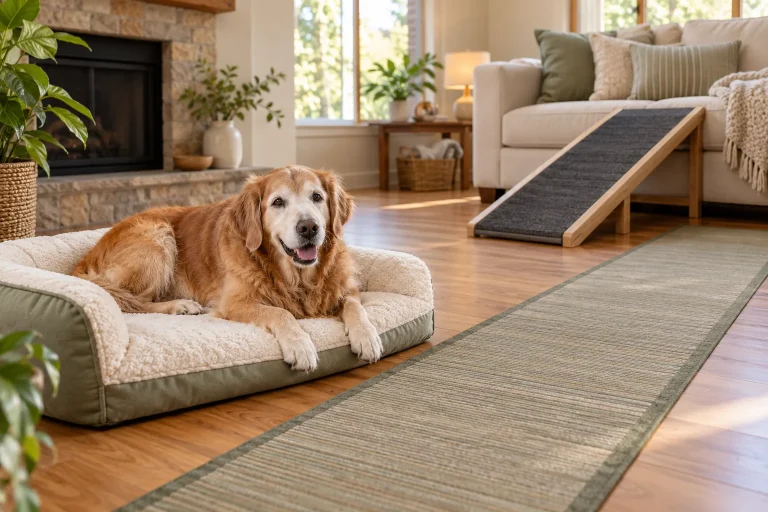
AAHA’s senior-care guidance places fitted, padded lifting harnesses within a wider mobility plan that can include traction, ramps, beds and rehabilitation. The product should fit the household route as well as the dog. Our home modifications checklist helps identify practical obstacles before you buy additional equipment.
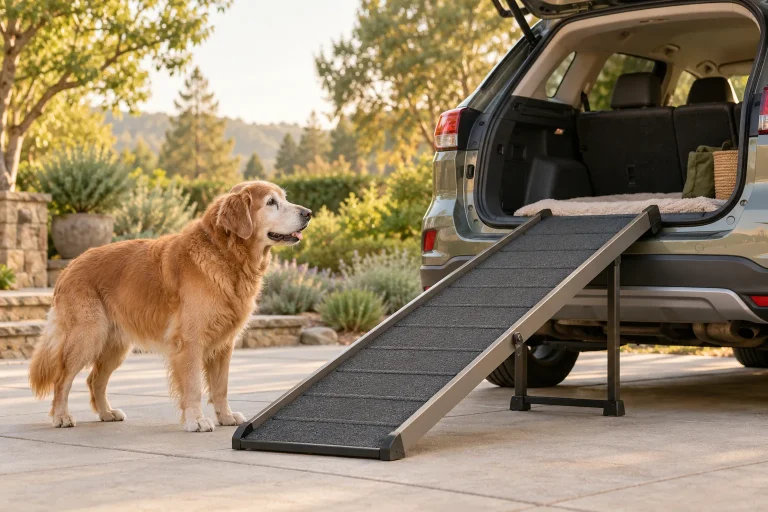
If vehicle entry is the main problem, measure it and discuss whether supported ramp use or another transfer is appropriate. The senior-dog ramp comparison covers dimensions that matter at the landing. Do not assume that combining a ramp and harness creates an approved handling method; the caregiver needs a workable position throughout the task.
Review changing assistance needs with the veterinary team. Use our mobility buying guide to give each purchase a clear job.
Frequently asked questions
Can every dog harness with a handle lift the whole dog?
No. Check the manufacturer’s explicit function and restrictions. For example, the Warrior Front instructions state that it should not lift a dog off the ground, despite its handle and wheelchair compatibility. Walking control and complete lifting are different functions.
What is the difference between the Original Walkabout and Airlift One Combination?
The Original uses neoprene and offered handle lengths. Airlift One uses breathable airprene, adjustable handles and additional male clearance. Both require correct front and rear sizing; compare the actual material and handle arrangement rather than choosing by the names alone.
Can I use a complete lifting harness as a car seat belt?
Do not assume a mobility harness is a vehicle restraint. Use only the transport functions explicitly specified by its manufacturer. Plan vehicle restraint separately from the equipment used to assist entry and exit.
Is a full-body harness better than a rear sling?
Only if its support format matches the task and veterinary plan. Additional sections create more fitting and cleaning steps. Rear-only support may suit some tasks, while coordinated front-and-rear assistance is needed for others.
Sources and verification
Manufacturer documentation checked October 17, 2026. This shortlist compares four two-part support systems and one manufacturer-described lift sling. It does not establish individual medical suitability or a safe lifting load for a caregiver. No hands-on tests, live Amazon-listing verification or systematic purchaser-review analysis were performed.
- Help ’Em Up: construction and support points; rear styles and mandatory front connection; fitting instructions.
- PetSafe: complete CareLift system, accessories and sizing.
- Walkabout: Original front-and-rear Combination and connector option.
- Walkabout: Airlift One Combination materials, handles and sizing; Original versus Airlift construction comparison.
- Walkabout: Walkabelly Support Lift construction, measurements and handle lengths.
- Walkin’ Pets: explicit Warrior Front lifting restriction.
- AAHA: senior-pet mobility accessories within a wider care plan; emergency signs.
About the author
Grace Wilder
Grace Wilder writes about senior-dog mobility and everyday comfort for PawRampGuide. She covers dog ramps, support harnesses, orthopedic beds, and practical home adjustments, focusing on product fit, ease of use, and clear comparisons. Her goal is to help owners make thoughtful choices that support their aging dogs’ daily routines. Her articles provide general information, with individual health and mobility decisions guided by a veterinarian.