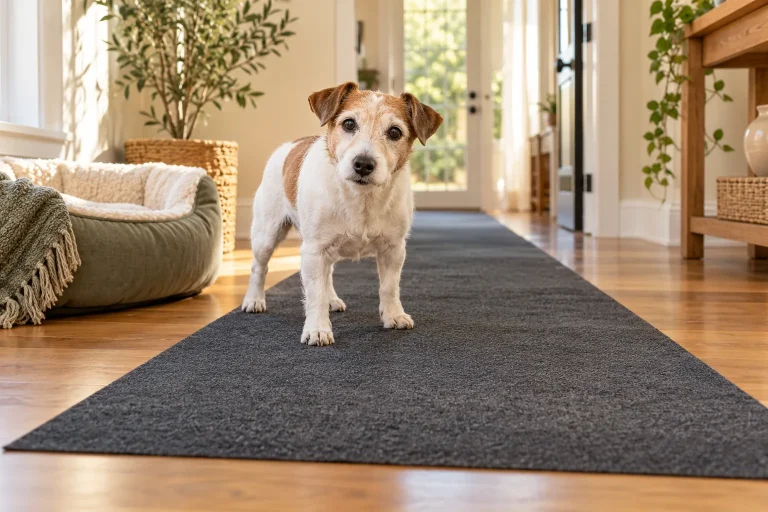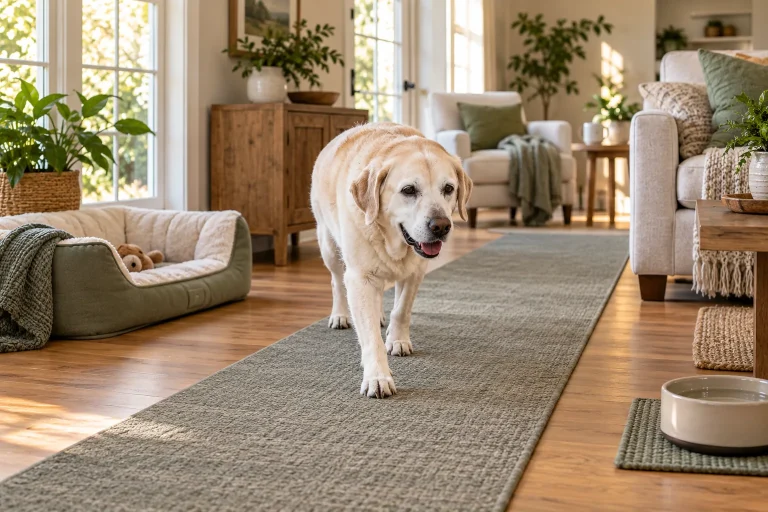
If your senior dog is slipping on hardwood floors or tile, address both the environment and the dog’s health. Build a continuous, stable route between important places, keep surfaces dry and ask your veterinary team about a new or worsening change in movement. A rug can improve one part of the journey; it cannot diagnose weakness or prove that an underlying condition has resolved.
Start where slipping actually happens: rising beside the bed, turning through a doorway, stopping at a water bowl or reaching the outdoor exit. These are different tasks. Covering the center of a room may leave the most difficult turn unchanged.
When a senior dog is slipping on hardwood floors
Notice whether the difficulty is limited to one surface or also occurs elsewhere. Record ordinary observations such as feet sliding apart while rising, toe scuffing or a new hesitation at a doorway. Avoid making the dog repeat a difficult route to confirm the pattern.
New weakness, recurrent falls or a changed gait deserves veterinary advice. Sudden weakness or paralysis is an emergency. Do not assume a floor finish explains every change simply because slipping is easiest to see there.
The mobility observation guide helps organize useful details for the appointment. If hind-leg weakness is part of the picture, the weak-back-legs guide explains how daily support fits around assessment and treatment.
Map the entire route, not isolated patches
List the destinations the dog uses most: resting place, water, feeding area, family activity and the toilet route. Connect them on a simple floor plan or a written list. Mark turns, narrow passages, thresholds and places where a door swings across the path.
Identify the first and last steps of each task. A runner down the hallway may help forward walking but do little for getting off a bed if the paws first land on a smooth patch. A mat at the bowl may miss the point where the dog turns away from it.
Give particular attention to corners and changes of direction. Plan enough stable surface for the ordinary turn instead of expecting the dog to make a precise pivot on a small rectangle. Keep furniture and clutter out of the route so the dog is not forced to sidestep around them.
A practical route example
Imagine a dog moving from a floor bed through a bedroom doorway, along a hall and out to the garden. Assess the bed exit, the doorway turn, the straight hall, the threshold and the outdoor arrival separately. This is an illustrative planning example, not a reported owner case or a tested layout.
If you can only change part of the route initially, prioritize the task with the veterinary team and maintain an appropriate alternative. A patchwork of unstable temporary materials is not necessarily an improvement over a clear, supervised arrangement.
Choose a surface that works as a system
Compare the top texture, backing, total thickness and edge construction. A soft surface can feel reassuring to a person yet be difficult for a particular dog to place the feet on. A thin cover can still move if its required pad is missing or incorrectly fitted.
Confirm that the product is intended for the location and compatible with the floor. Some backings or adhesives are unsuitable for particular finishes, moisture conditions or heated floors. Follow the specific product and flooring instructions, especially when a model-specific warning is more restrictive than a generic FAQ.
The mat and flooring comparison includes five actual household or pet products with different layouts. Inclusion does not mean they have been clinically tested for canine gait or proven to prevent falls. Assess the exact product and the individual route.
Check the whole installed height
A removable rug cover’s listed thickness may exclude its pad. A mat’s border can differ from the central surface. Measure or ask about the complete installed arrangement, including any underlay, so you understand the transition at the edge.
Avoid stacking loose layers to make one product work. That can create movement between layers or a higher edge. Use the manufacturer’s specified system and seek an alternative if the finished surface creates a trip or placement problem.
Lay out continuous coverage carefully
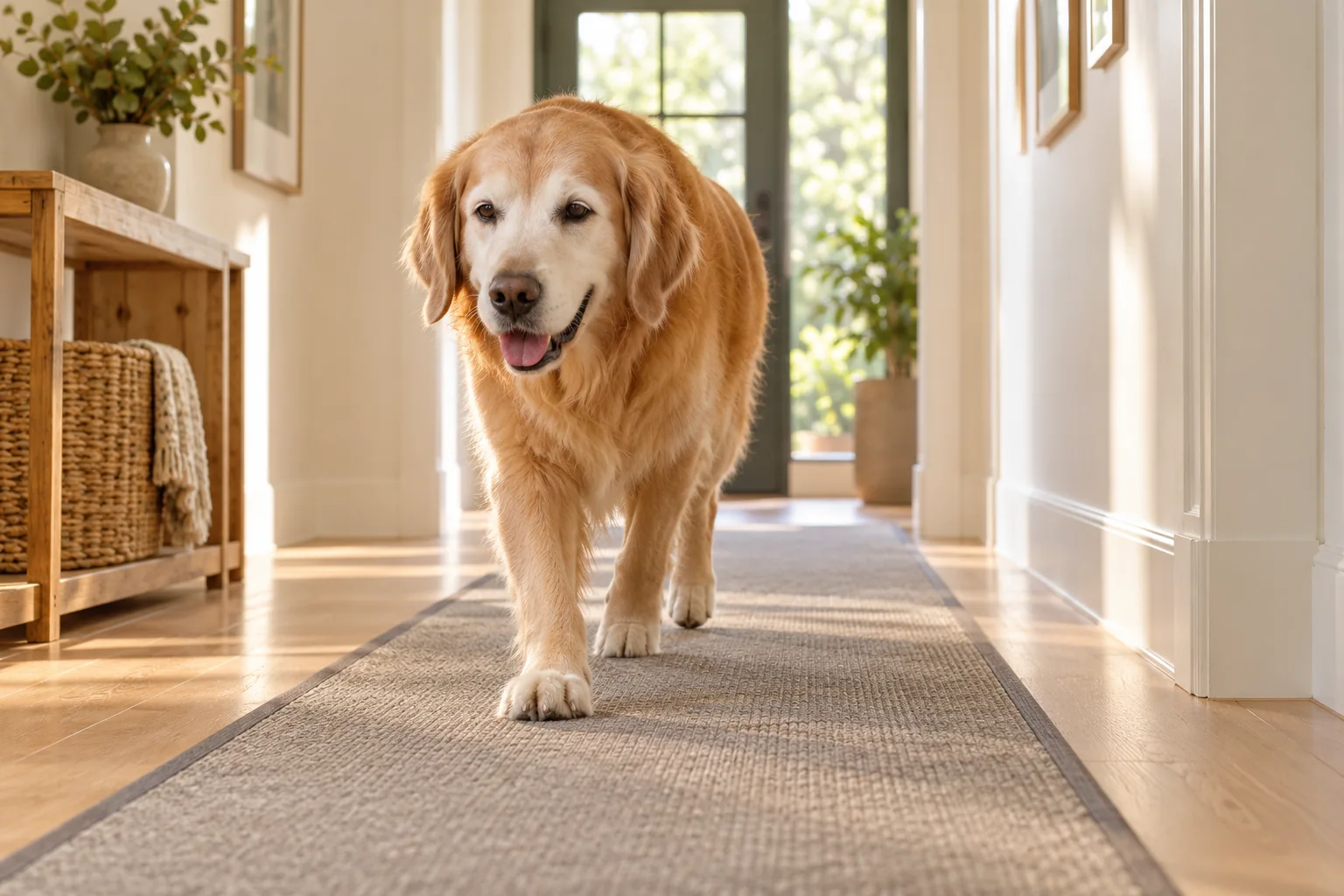
Position runners so they cover the path the dog naturally needs, not merely the most convenient line between furniture. Include resting-area exits and turning zones. Check that doors can open without pushing, bunching or lifting the covering.
Keep edges flat and inspect them from both directions. A border that looks tidy when viewed from one doorway may present a raised corner from the other side. If the mat repeatedly shifts, curls or catches at a threshold, revise the setup rather than accepting it as a normal inconvenience.
For modular carpet products, follow the specified connection and installation method. Do not assume tiles may be stuck directly to every floor or used on stairs. Measure the planned coverage and keep the maker’s restrictions with the household instructions.
Keep water and cleaning in the plan
Inspect around bowls, outdoor doors and recently cleaned areas. Dry the floor and the underside of a mat as directed before replacing it. A water-resistant surface can still have moisture underneath, and an absorbent top can become saturated.
Follow the care instructions for each layer. Some systems have a washable cover with a separate pad; others must be hosed or spot-cleaned, and carpet tiles may have their own restrictions. Washing the wrong component can change the fit or backing.
Plan coverage while an item dries. A frequently washed runner is less useful if its removal exposes the only essential route for hours. Keep an appropriate clean replacement or another supervised arrangement, and store it where caregivers can find it.
Review the floor-care routine
Ask the flooring manufacturer about compatible cleaning products and finishes. Avoid improvised treatments marketed as making floors “grippy” without understanding residue, finish damage or pet-contact implications. Do not apply household substances to the dog’s paws to compensate for the surface.
Keep the ordinary route clear during cleaning and return it to a dry, stable condition before access. The aim is a maintainable household system, not a special surface that only works immediately after careful preparation.
Discuss paw, nail and footwear needs
Ask your veterinary team about nail length, fur between the pads and any skin or paw concerns. If handling is uncomfortable or stressful, arrange an appropriate professional care plan rather than forcing a home trim. Do not let a traction problem become a reason for an unsafe grooming attempt.
Boots, nail products and pad coverings are not interchangeable with floor changes. Their suitability depends on fit, tolerance, skin condition and the dog’s movement. Ask about the specific option and how it should be checked and maintained.
VCA discusses both environmental traction and individualized paw-support options. This guide does not prescribe a footwear model or a wear schedule. Even a well-fitted accessory does not remove the need to address wet areas, shifting rugs and difficult transitions.
Review rising, turning and stopping separately
At a bed, observe the complete movement to standing and the first steps away. Check whether the bed moves, the cover bunches or the feet land beyond the stable area. Changing the surrounding coverage may be relevant alongside the mattress itself.
At a turn, consider the available width and nearby objects. A narrow runner squeezed against a wall can still force an awkward route when a door opens. Give the dog a clear destination and avoid placing a tempting bed or water bowl where reaching it requires a tight turn.
At a stopping point, check that the stable surface extends through the task and departure. The home modification guide connects these details with furniture, rest and outdoor access.
Make maintenance repeatable for every caregiver
Write down which pad belongs under each covering, how it is cleaned and where the backup is stored. A household member should not have to guess whether a mat can go in the dryer or whether the floor underneath must be completely dry.
Ask people to report changes rather than quietly repositioning the route. If furniture moves, check the turns again. If a product is damaged or keeps curling, remove it from use while arranging a suitable alternative.
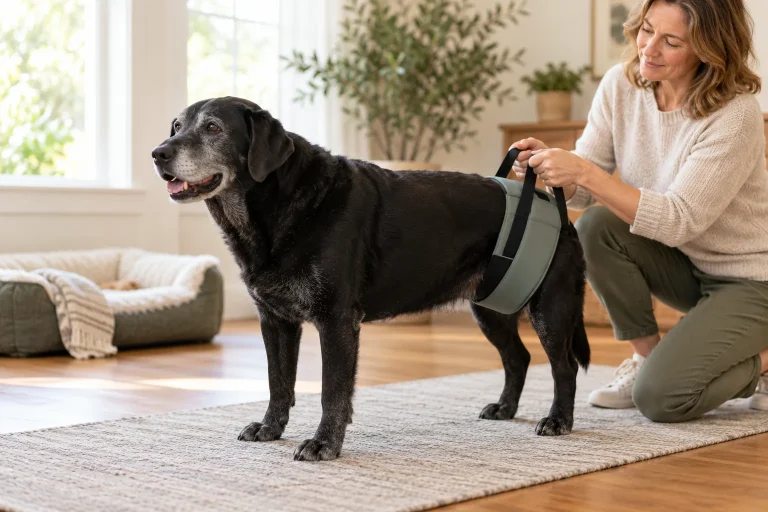
If the dog requires a support harness, keep the fitting and handling method consistent with the veterinary plan. Do not use the handle to drag the dog across a difficult patch. The environment and prescribed assistance should work together.
Keep a short route-review log
| Check | Record | Action if it is not working |
|---|---|---|
| Coverage | Bed exit, turn, hallway, bowl and threshold. | Revise the layout or route, avoiding unstable patches. |
| Condition | Dryness, edges, backing and installation. | Clean, refit or replace according to instructions. |
| Dog’s ordinary movement | Plain observations during permitted activity. | Discuss persistent or changing difficulty with the vet. |
| Caregiver routine | Cleaning, backup coverage and prescribed assistance. | Change the plan if it cannot be followed consistently. |
Use ordinary permitted movement rather than staging a slippery-floor test. A reduction in visible sliding is useful information, but it does not measure muscle strength or prove that pain is controlled. Keep the findings separate and share relevant changes at review.
Avoid fixes that add another problem
Do not choose a material solely because the dog stays on it once. Check the next turn and the route when it is damp, being cleaned or used by the rest of the household. Do not ignore a high edge because the central texture appears better.
Be cautious about exposed foam or loose pieces where a dog may chew. A flooring surface intended for people is not automatically appropriate around a destructive pet. Follow the product’s intended use and supervise according to the individual care plan.
Finally, avoid treating “non-slip” as a permanent guarantee. Materials, floors and the dog’s needs change. A maintained route and ongoing health assessment are more useful than a label that discourages further observation.
Frequently asked questions
Will rugs solve my dog’s slipping?
They may improve a particular surface, provided they remain stable and flat. New or persistent slipping can also reflect a health or movement problem that needs veterinary assessment.
Should I use small mats or a long runner?
Choose coverage for the complete task, especially turns and bed exits. Several small mats can leave difficult gaps; a long runner can still fail if it moves or misses the route.
Are boots better than changing the floor?
There is no universal answer. Discuss the dog’s fit, tolerance and skin or gait needs with your veterinary team. Footwear does not replace environmental maintenance.
What if the dog still hesitates after traction is added?
Review the installation, transitions and the dog’s health. Do not pull them across the area to prove the new surface works. Seek advice if the difficulty persists or worsens.
Sources and editorial basis
- VCA: Home adaptations and individualized traction options.
- Cornell: Supportive management for a specific mobility condition — does not establish a diagnosis from slipping.
- AAHA: Emergency signs.
- Route examples and maintenance worksheets are original editorial planning aids. They are not clinical traction tests or fall-prevention guarantees. Sources checked October 17, 2026.
About the author
Grace Wilder
Grace Wilder writes about senior-dog mobility and everyday comfort for PawRampGuide. She covers dog ramps, support harnesses, orthopedic beds, and practical home adjustments, focusing on product fit, ease of use, and clear comparisons. Her goal is to help owners make thoughtful choices that support their aging dogs’ daily routines. Her articles provide general information, with individual health and mobility decisions guided by a veterinarian.