Signs your senior dog needs mobility help can include difficulty rising, hesitation at familiar transitions, slipping, a changed gait or needing more assistance with everyday tasks. These changes are reasons to arrange veterinary assessment, not a diagnosis or an automatic instruction to buy a ramp. The right support depends on what has changed and why.
Start with ordinary routines: getting out of bed, walking to water, turning through a doorway and reaching the toilet area. Notice whether those tasks have become slower, less controlled or uncomfortable. Clear observations help the veterinary team assess the dog and choose an appropriate care and equipment plan.
1. Getting up or lying down has changed
Watch how the dog moves during a normal transition from rest. Perhaps they make repeated attempts, pause midway or use a different sequence than before. Record what you see and the surface involved. Do not repeatedly ask the dog to get up to determine whether it happens every time.
Consider the environment as part of the description. A shifting cover, high bed edge or smooth patch beside the mattress may complicate a movement that is already difficult. Improving that part of the route can be useful, but a new difficulty rising still deserves assessment rather than being attributed entirely to bedding.
If a bed change is appropriate, compare entry height and sleeping area as well as cushioning. Our low-profile bed guide explains how a mattress can offer easier access without assuming that a thick or soft surface is always the right choice.
2. Familiar steps or raised destinations are being avoided
A dog may hesitate before a staircase, stop at a car door or remain beside furniture they previously approached readily. Record whether ascent, descent or the final landing seems difficult. Avoid using treats to lure the dog through the movement simply to check whether they are still capable of it.
Avoidance can have several explanations, including discomfort or a changed environment. It does not establish that the dog is stubborn or that a ramp will solve the issue. Ask about the permitted route before choosing a different access aid.
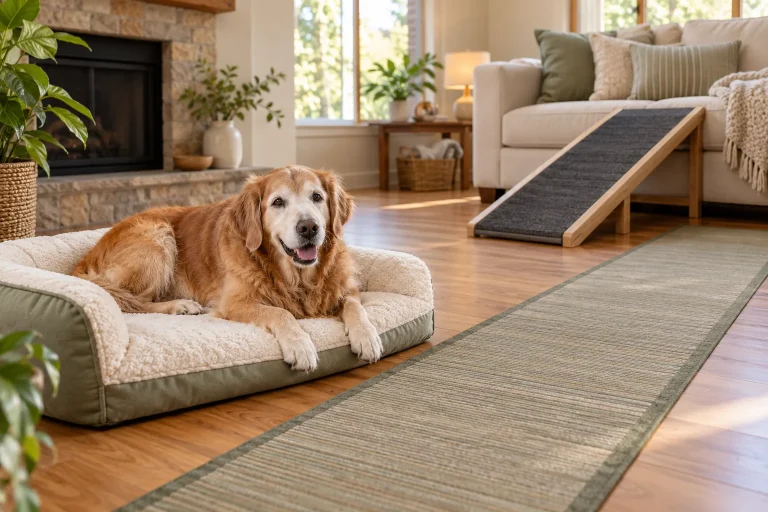
The ramps-versus-stairs guide compares the demands of each format. A shorter flight of steps may occupy less room, while a ramp introduces a slope and specific transitions. Neither format is a universal approval for an aging dog.
3. Slipping or uncertainty appears on ordinary floors
Notice where the feet move unexpectedly: while rising, starting forward, turning or stopping. Note whether it occurs on one surface or throughout the home. The location and movement can be more informative than the number of times someone says the dog “looks nervous.”
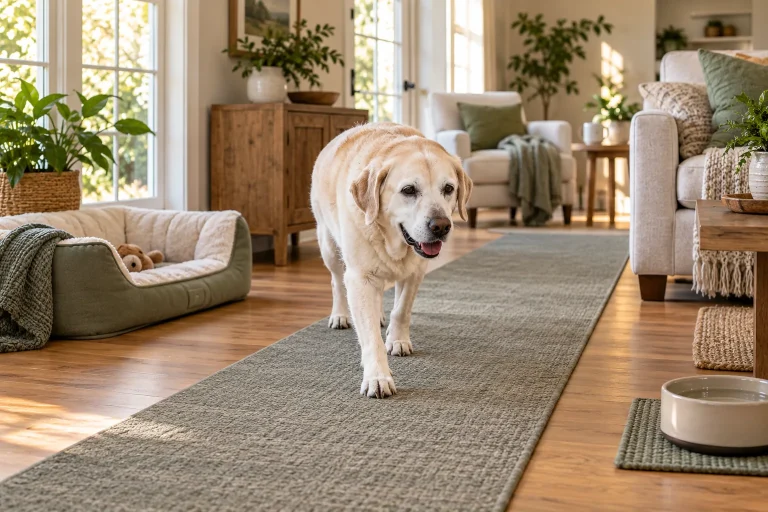
Check for moisture, loose mats and clutter without asking the dog to repeat the difficult route. A secure surface may help with the environmental part of the task. If slipping is new, recurrent or accompanied by weakness, discuss it with the vet even if a runner appears to improve one location.
The hardwood and tile guide helps map continuous traction, corners and entry points. More coverage is not automatically better if it creates curled edges or unstable layers.
4. The walking pattern looks different
Useful observations include limping, shorter steps, crossing feet, toe scuffing or difficulty placing a paw normally. Do not use these descriptions to identify a particular disease at home. Several musculoskeletal and neurologic problems can affect movement, and an older dog can have more than one issue.
Take a short video during ordinary safe activity if it will help the veterinary team. Record the surface and context with it. Do not manipulate a paw, test pain sensation or deliberately make the dog walk on a challenging surface to demonstrate the problem.
A change that is sudden or rapidly worsening needs prompt veterinary direction. A dog does not need to cry, refuse all food or stop greeting the family before a mobility concern becomes worth reporting.
5. Walks and family activities are becoming different
The dog may turn back earlier, pause more, choose a different resting place or stop joining an activity. Describe what changed from their own usual routine rather than comparing them with a younger dog or a breed stereotype.
Reduced participation can have causes beyond the legs, including broader health or sensory changes. Tell the veterinary team about the complete pattern. Do not create an exercise challenge to distinguish “fitness” from illness, or increase distance because an online article gives a target for senior dogs.
Think about the underlying goal. If the dog wants to remain near people but finds repeated room changes difficult, accessible resting places near normal activity may help the household routine. That is different from expecting the dog to keep following every movement through the home.
6. Settling, posture or behavior has changed
Restlessness, a changed resting position, withdrawal or irritability can be useful information for the vet. Merck’s pain guidance emphasizes knowing the animal’s normal behavior and recognizing that signs can be subtle. None of these behaviors alone proves a particular pain source.
Record when it happens and what else is different. A dog who repeatedly leaves a bed may dislike the location, struggle with the entry or have a health concern. Avoid treating every change as proof that the latest mattress or supplement will solve the problem.
Discuss persistent changes even if the dog still eats, wags their tail or has periods of enthusiasm. A familiar reassuring behavior does not substitute for an assessment of a new difficulty.
7. Toilet trips or caregiver assistance are changing
Perhaps the dog now waits at a threshold, needs help maintaining a position or cannot manage the usual route in time. Describe the sequence. A household accident can reflect several issues and should not automatically be interpreted as a training failure.
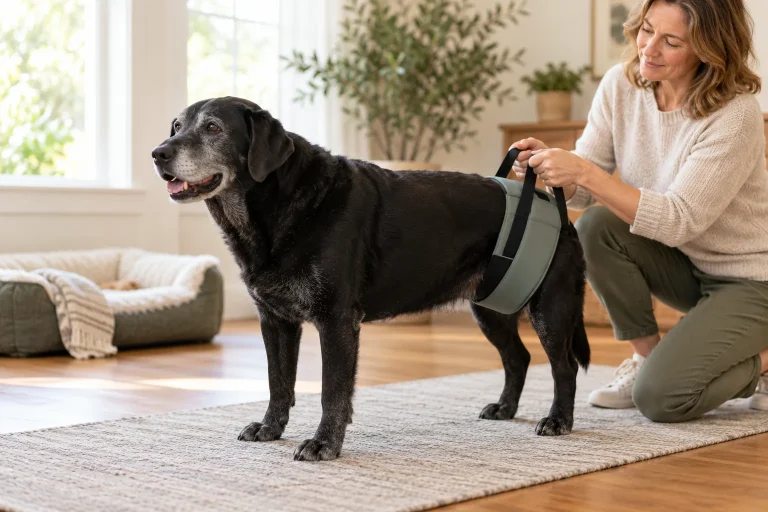
Report changes in urination or elimination, especially when they occur with a new hind-leg problem. A support harness may assist a movement, but an open design does not establish normal bladder function. The veterinary team should determine whether further care or investigation is needed.
Also notice when the caregiver routine is no longer manageable. If a person cannot safely provide the current support, the plan needs adjustment. That concern matters even if the dog’s measurements and product size have not changed.
Record signs your senior dog needs mobility help
| Observation | Useful details | Question for the veterinary team |
|---|---|---|
| Harder to rise | Bed height, surface and ordinary sequence. | Is treatment, environmental change or assistance needed? |
| Hesitation at access | Ascent, descent, transition and available space. | Which movements should be permitted or avoided? |
| Slipping | Location, turn, moisture and existing mats. | How much is environmental, and what else needs assessment? |
| Changed gait | Timing, side, toe scuffing or coordination changes. | What assessment and urgency are appropriate? |
| More assistance | Task, prescribed aid and caregiver limitations. | Does the support format or handling plan need revision? |
Keep the notes brief enough to maintain. Record a change from the dog’s own baseline, not a homemade mobility score that implies clinical precision. The notes are a conversation aid; they should not delay an urgent call or replace the examination.
What to do with these observations
Contact your veterinary team and describe the timing and severity of the change. Ask how urgently the dog should be seen and how to manage transport or essential movement in the meantime. Follow existing restrictions rather than beginning a new activity or testing a device.
Make simple route observations without putting the dog through a trial: identify clutter, unstable rugs, wet patches and inaccessible supplies. Ask about changes that can be made while awaiting assessment. Do not use improvised elevated surfaces, strenuous practice or a new lifting technique.
At the appointment, bring the notes and a full medication and supplement list. Discuss who provides care and which daily tasks have become difficult. That information can materially change a plan for support, rest or home access.
Match the aid after the need is understood
Ramps address permitted raised access; support harnesses assist specified movements; beds provide a resting surface; floor changes improve parts of the environment. These are functions, not diagnoses. Buying one item from every category is not a substitute for identifying the task and cause.
If help is needed with standing or walking, review the support-harness comparison alongside a fitting demonstration. For raised access, use measured geometry and manufacturer instructions. For rest, consider entry and room layout as carefully as foam.
The complete mobility guide connects these decisions. Choose a small set of appropriate changes, then review whether the original daily task actually became easier. A product that looks suitable in a photograph may still need a different fit or route.
Review the plan as needs change
Keep the team informed when a previously manageable task becomes difficult, more assistance is required or comfort changes. Do not assume that last year’s product or handling method remains appropriate. Weight, body shape, health, flooring and caregiver abilities can all change.
Maintain instructions and a clear household routine. Ask caregivers to report what happened rather than quietly adding tension to straps or changing how the dog is lifted. A consistent record helps distinguish an equipment issue from a change that needs medical attention.
The purpose of noticing early changes is to improve the care conversation and daily routine. It is not to label the dog by a score or preserve every activity at its old level. Suitable support should reflect the dog who is in front of you now.
You do not need to see every sign
One meaningful change can be enough to start a conversation with the veterinary team. Do not wait for a complete list or treat the absence of one sign as reassurance that another is unimportant. Explain the change, its timing and its effect on normal tasks, then follow the advice about urgency.
Also describe what remains comfortable and familiar. Knowing that the dog can settle in one place but struggles with a particular transition can help frame questions about the environment alongside the examination. It is useful context, not a way to rule out a health problem at home.
Frequently asked questions
Does hesitation mean my dog needs a ramp?
Not necessarily. Identify whether the issue is the movement, surface, destination or a health change. A ramp is one possible route aid after suitability is assessed.
Should I wait until the dog refuses to walk?
No. New or persistent movement and behavior changes are worth discussing before they become severe. Sudden weakness or paralysis requires immediate care.
Is slowing down normal in a senior dog?
Do not assume an unexplained change is simply age. Tell the veterinary team what changed so that possible causes and support needs can be assessed.
Can an observation log diagnose arthritis?
No. It helps describe home behavior and function. Diagnosis and an appropriate care plan require veterinary assessment.
Sources and editorial basis
- VCA: Signs of osteoarthritis — movement and activity changes worth reporting.
- Merck Veterinary Manual: Recognizing and Assessing Pain — behavior and individual baseline.
- Cornell: What to Expect at a Lameness Appointment.
- AAHA: Emergency signs.
- The observation table is an editorial discussion aid, not a validated diagnostic tool. Sources checked October 17, 2026; no veterinary review of this article is claimed.
About the author
Grace Wilder
Grace Wilder writes about senior-dog mobility and everyday comfort for PawRampGuide. She covers dog ramps, support harnesses, orthopedic beds, and practical home adjustments, focusing on product fit, ease of use, and clear comparisons. Her goal is to help owners make thoughtful choices that support their aging dogs’ daily routines. Her articles provide general information, with individual health and mobility decisions guided by a veterinarian.