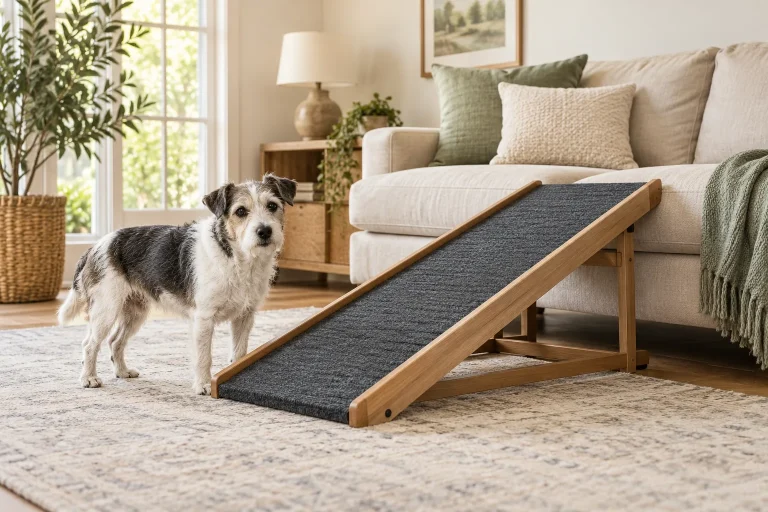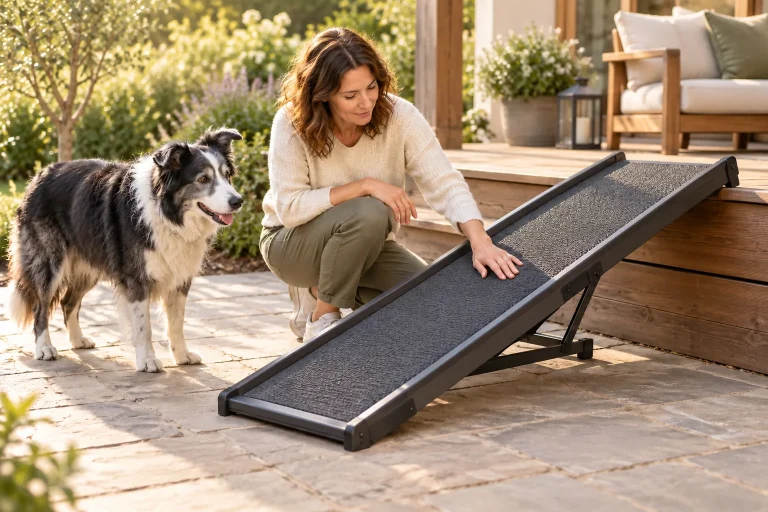
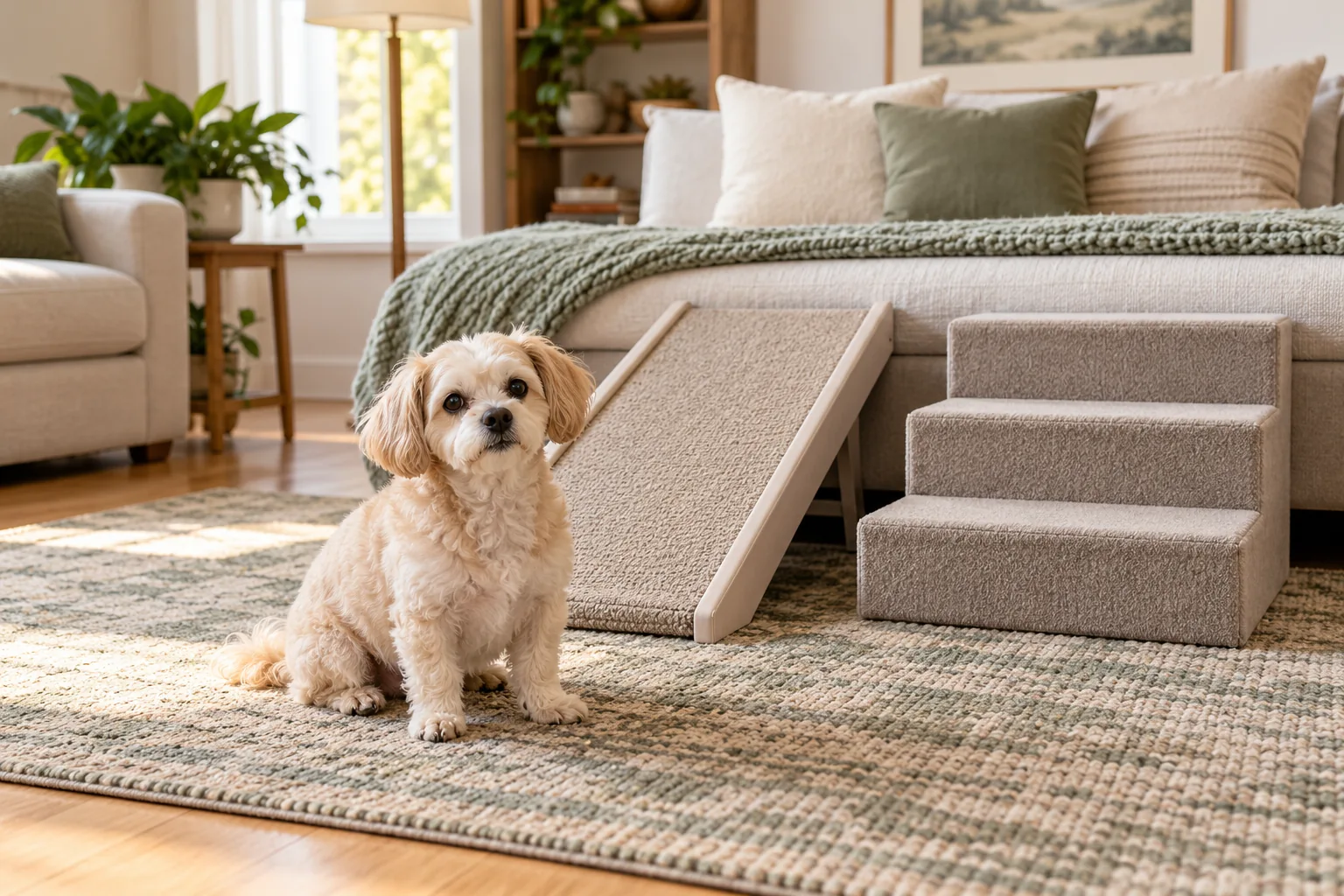
The answer to dog ramps versus stairs for senior dogs depends on the dog’s movement and the actual setup. A ramp replaces separate steps with an incline; stairs divide the rise into individual treads and risers. Either can be unsuitable if it is too steep, narrow, unstable or difficult to leave at the top. Start with veterinary guidance about the permitted movement, then measure the route.
There is no universal rule that every older dog should use the same format. A familiar stair unit is not automatically appropriate after a change in mobility, and a product called a ramp does not establish a gentle approach. Compare the geometry and transitions before deciding which option deserves a closer look.
What changes between a ramp and stairs?
A straight ramp provides a continuous sloping surface. The dog still needs to place the feet, maintain balance and negotiate the lower and upper transitions. A short ramp at a high landing creates a steeper incline than a longer ramp at that same height.
Stairs provide a series of separate level surfaces with height changes between them. The height of each riser and usable depth of each tread affect the movement. Counting the steps alone does not describe whether the dog has room to place their feet or pause comfortably.
Both formats require a suitable final landing. A gap between a unit and the sofa, a moving cushion or an awkward turn at the top can undermine an otherwise plausible product choice. Look at the complete route rather than assuming the middle section is the only important part.
Dog ramp versus stairs: practical comparison
| Decision | Ramp questions | Stair questions |
|---|---|---|
| Movement | Can the dog manage the particular slope and both transitions? | Can the dog manage each rise and place the feet on each tread? |
| Space | Is there room for usable length plus a level approach? | Do the tread layout and landing fit without an abrupt turn? |
| Width | What is the clear walking surface between edges? | Is every tread wide enough for the actual gait? |
| Support | Are upper contact, base and locking parts secure? | Does the complete unit remain stable during use? |
| Surface | Is the covering appropriate, maintained and permitted for the setting? | Are tread surfaces secure, consistent and free of loose covering? |
| Handling | Can the caregiver deploy, store and supervise it safely? | Can the caregiver position it and provide prescribed help without crowding the route? |
When a ramp may be worth discussing
A ramp may be a candidate when the permitted movement should avoid individual steps and there is enough room for a suitable incline. That is a conditional reason to investigate, not a medical approval. Share the measured rise, usable length and layout with the veterinary or rehabilitation team.
For a vehicle, a folding or telescoping ramp may offer a manageable storage routine. Check the real landing and parking space rather than assuming travel products are interchangeable. Some vehicle systems have model-specific height or attachment restrictions that an angle calculation cannot override.
For furniture, a longer permanent ramp may occupy much of the available room. Mark its footprint before buying and preserve access for doors and people. The indoor ramp guide compares different heights and formats, while the selection guide explains the measurements behind them.
Why “ramp” does not necessarily mean shallow
At a 20-inch rise, a straight usable ramp length of 60 inches creates an incline of about 19.5 degrees and a horizontal run of about 56.6 inches. A shorter usable length increases the angle at that same rise. These figures explain space requirements; they are not a safe-angle prescription.
Do not compare a ramp’s horizontal footprint with another model’s sloping length as if they were the same measurement. Platforms and multiple sections also change the geometry. Read the drawing or manual and ask what the listed length includes.
When stairs may be worth discussing
A stair unit may be a candidate when the dog can comfortably manage the individual rises, the tread layout fits and the veterinary plan permits the movement. It can be practical in some furniture layouts, but a smaller footprint does not automatically make it easier for the dog.
Ask for actual riser height, tread depth and clear width. Check whether the upper tread reaches a stable landing without an extra jump or stretch. A unit with several small-looking steps may still have a final transition that is inappropriate.
Materials and construction affect the questions to ask. If a soft stair product changes shape under load, ask the maker about intended use and support rather than assuming the photograph represents its loaded form. If a rigid unit folds or adjusts, inspect the relevant locks. We have not tested particular stair models in this guide.
Do not let familiarity substitute for reassessment
A dog who used household stairs for years may need a different plan after injury, surgery or a change in balance. A dog unfamiliar with a ramp may need patient learning even when the physical route is suitable. Previous experience and current physical ability are separate considerations.
Similarly, do not assume a small breed needs tiny steps or a large breed needs a particular ramp solely from body weight. Proportions, gait, condition and available space can lead to a different choice. Use the individual dog’s ordinary movement and professional assessment.
Let the health context shape the choice
Tell the veterinary team why the dog needs a different route. A chronic joint problem, acute injury, neurologic change and postoperative restriction can require different handling. A general comparison cannot replace a plan for one of those situations.
After surgery, ask explicitly whether the raised destination is permitted and whether any ramp or stairs should be used. A low-impact marketing label does not cancel an activity restriction. Sometimes keeping rest and essential care on one level is the appropriate arrangement while healing is assessed.
For new movement changes, start with the mobility observation guide and veterinary advice. Sudden weakness or paralysis is an emergency. Do not test the dog on both formats to identify which condition they might have.
Checks that matter for both formats
Inspect the complete product before introducing the dog. Match the label to the ordered model, read setup instructions and confirm that every required component is present. Stay within the manufacturer’s stated pet limit and permitted setting.
Keep the base and surrounding route stable, dry and uncluttered. Secure coverings as instructed, check edges and replace worn parts appropriately. A non-slip claim does not guarantee performance on every floor or with every dog.
Check edge protection realistically. Small lips or decorative rails may help define a route but are not necessarily designed to contain a falling dog. Supervision remains important. Avoid placement that encourages a shortcut jump off the side or requires an immediate turn beside an exposed drop.
Include the caregiver’s position and the dog’s waiting area while equipment is moved. Do not let the dog approach a partly unfolded unit. If the prescribed assistance cannot be provided without standing on equipment intended only for pets, the route needs another plan.
Introduce the chosen aid gradually
Once the physical route is appropriate, use small voluntary steps and rewards. Let the dog investigate a securely placed product without requiring a complete crossing. Use only introductory positions the manufacturer allows; some ramps cannot safely be laid flat.
The American Kennel Club recommends positive introduction and avoiding pushing or pulling a reluctant dog onto the equipment. A hesitation can reflect unfamiliarity, discomfort or an unsuitable setup. Do not assume it is a training failure that should be overcome with more pressure.
Practise ascent and descent as separate tasks under the agreed plan. Keep the lower exit clear and allow the dog to finish without a collision or sharp turn. Our ramp training guide provides a progression and observation log, while keeping physical suitability first.
When neither format is the useful answer
Sometimes the destination itself should change. A comfortable floor-level resting place near the family may meet the dog’s needs more simply than continuing access to a high bed. A different vehicle transfer plan may be more practical than a ramp that cannot fit the parking space.
Discuss alternatives if the dog cannot comfortably use either route or if the caregiver cannot manage the setup. A support aid can have a role when professionally selected, but adding a harness does not automatically make an unsuitable ramp or stair unit appropriate.
The home modification guide helps review the whole layout. Judge the plan by whether an important daily task becomes manageable, not by whether a new product preserves every old routine.
A short decision sheet
- What is the necessary destination, and is raised access currently permitted?
- What movement does the veterinary team consider appropriate?
- What are the actual rise, width, approach space and landing details?
- For stairs, what are the individual riser and tread dimensions?
- For a ramp, what is the usable inclined length and how is it supported?
- Can the dog and caregiver manage the entire sequence in both directions?
- What alternative is available during introduction or if the plan changes?
Keep the answers with the product instructions and recheck them after a change in the dog, location or caregiver. A familiar route can stop being suitable, and a review should consider health and layout before simply replacing one product with another.
Review the route when the household changes
A moved sofa, replacement mattress, new vehicle or different caregiver can alter a previously workable arrangement. Check the landing and both directions of travel again rather than keeping the old position because the dog remembers it. Keep lighting and the surrounding path predictable, especially during overnight use.
Record the reason for the original choice and the relevant professional advice. That makes it easier to review the plan after a change in health without assuming that the opposite product category must now be the answer. A useful comparison remains tied to the task, not a permanent preference for ramps or stairs.
Frequently asked questions
Are ramps always better for dogs with arthritis?
No universal choice follows from the diagnosis alone. The particular movement, incline or step dimensions, stability and veterinary assessment matter.
Are stairs better when there is little floor space?
They may fit some rooms more compactly, but the dog still needs to manage each rise and tread. A smaller footprint is not a reason to ignore an unsuitable movement.
Can I replace stairs with a short ramp after surgery?
Ask the surgeon first. A ramp can still be restricted or inappropriate, and a short one can create a substantial incline. Follow the patient-specific discharge plan.
What if my dog rejects both?
Pause, review the physical task and seek appropriate advice. Consider a different destination or care arrangement rather than forcing use.
Sources and editorial basis
- AKC: Choosing dog stairs and ramps — individual fit and gradual introduction.
- VCA: Exercise Restriction in Dogs — patient-specific limits on stairs and furniture access.
- AAHA: Emergency signs.
- Comparisons describe product formats and original geometry, not a head-to-head clinical trial or hands-on product test. Sources checked October 17, 2026.
About the author
Grace Wilder
Grace Wilder writes about senior-dog mobility and everyday comfort for PawRampGuide. She covers dog ramps, support harnesses, orthopedic beds, and practical home adjustments, focusing on product fit, ease of use, and clear comparisons. Her goal is to help owners make thoughtful choices that support their aging dogs’ daily routines. Her articles provide general information, with individual health and mobility decisions guided by a veterinarian.