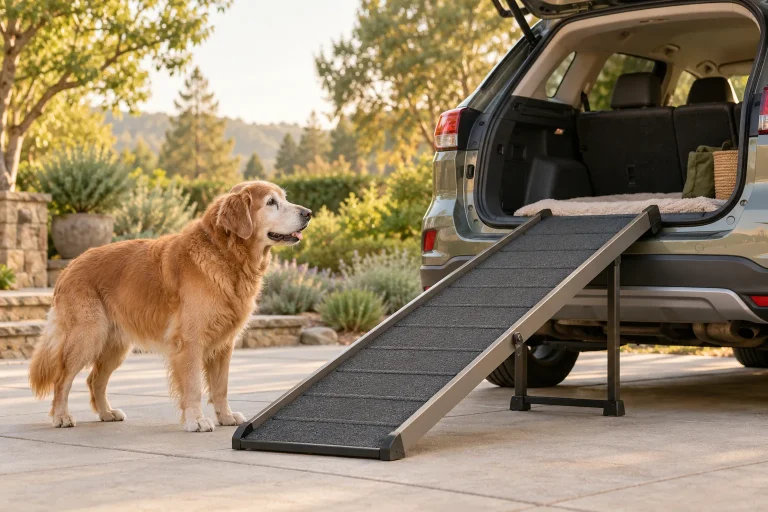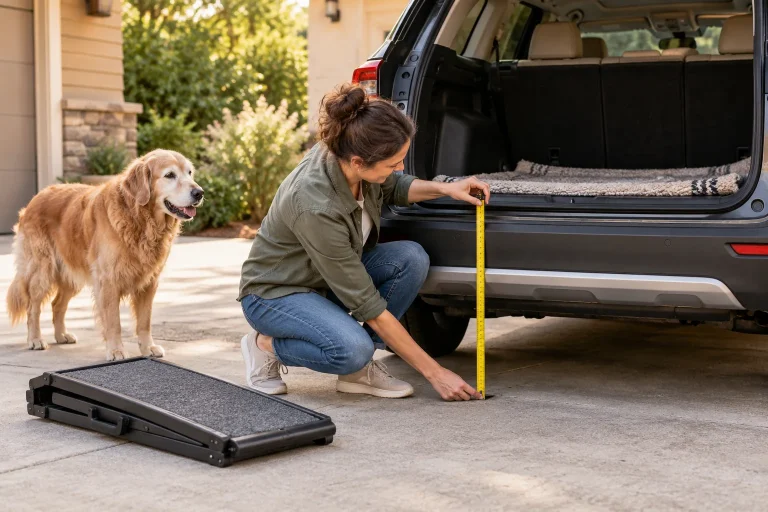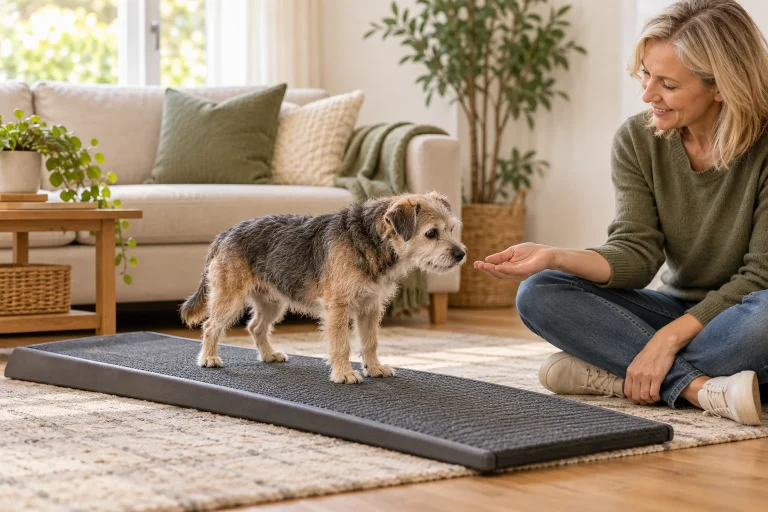
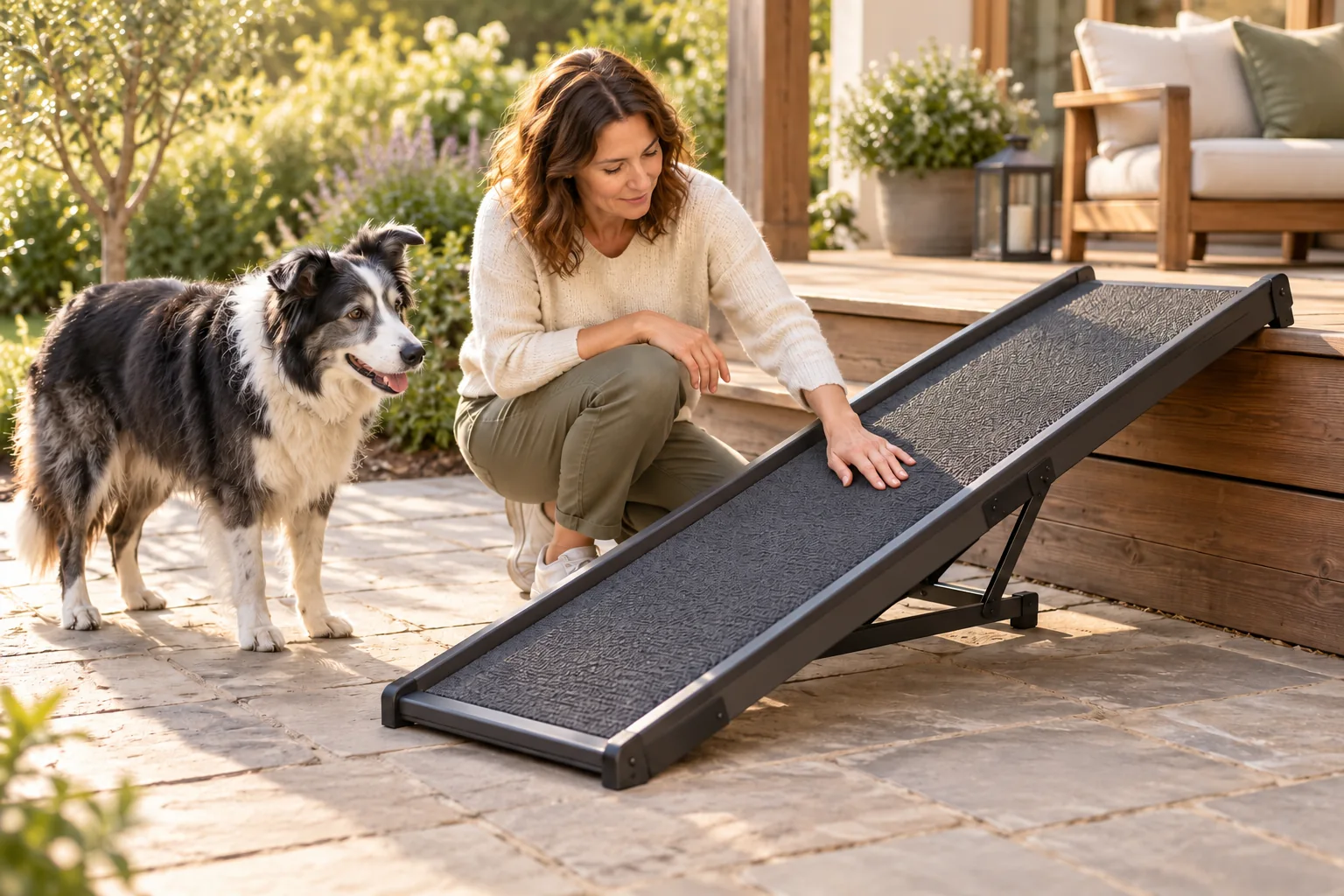
If you are deciding how to choose a dog ramp, start with the route rather than a product ranking. Measure the vertical rise to a suitable landing, the space available for the approach, and the dog’s practical walking needs. Then compare usable length, width, surface, support at both ends and caregiver handling. A ramp’s advertised capacity cannot answer those questions on its own.
For a senior dog or a dog recovering from illness or surgery, ask the veterinary team whether the proposed movement is appropriate before selecting equipment. This guide explains measurements and shopping decisions. It does not establish a safe incline for an individual dog or replace a demonstration of support and handling.
How to choose a dog ramp: define the journey
Write one sentence describing the task. “Reach the cargo area of our SUV from a level driveway” identifies a landing and a setting. “Needs a ramp for arthritis” leaves those details unanswered. Indoor bed access, a garden threshold and a vehicle side door can require quite different designs even when the dog’s weight is unchanged.
Include the trip back down. A ramp positioned well for ascent can leave an awkward lower exit, while a narrow upper landing may require an immediate turn. Map the complete sequence: approach, step onto the surface, climb, leave the ramp and settle. Keep the handler’s position in that sequence as well.
Think about the destination you actually need. If the goal is comfortable rest near the family, a floor-level bed may meet it without maintaining access to a high sofa. If the goal is travel to the veterinary clinic, consider the space available there as well as at home. The most convenient route in one place may be unavailable at the other.
Measure the vertical rise to the correct landing
Measure straight up from the surface supporting the ramp’s base to the point that will support its upper end. Use a firm, suitable location and the vehicle or furniture in its normal position. A bumper edge, door sill and cargo floor are different surfaces; do not substitute whichever is easiest to reach with a tape.
Identify a contact point the manufacturer permits. Decorative trim, flexible upholstery and an unsupported lip are not automatically structural landings. Check whether the design needs overlap, a supplied tether or an approved adapter. If that information is unclear, resolve it with the maker before ordering.
For furniture, measure the actual sleeping or sitting surface and any frame that projects beyond it. A mattress can compress when the dog arrives. A nominal bed height may therefore fail to describe the final transition. Record gaps, lips and possible sideways exits separately; one height measurement cannot capture the whole landing.
Understand length, incline and floor space
For a straight ramp, usable sloping length is the walking distance along the incline. Horizontal run is the ground distance it occupies. They are not interchangeable. An advertised assembled length may also include a platform or multiple sections, so read the design information before treating it as one sloping line.
With vertical rise h and usable straight ramp length L, the incline is arcsin(h ÷ L). Horizontal run is √(L² − h²). Use the same unit for both measurements. The length must be greater than the rise for this right-triangle model to describe a nonvertical ramp.
A 24-inch rise with 72 inches of usable sloping length gives an incline of approximately 19.5 degrees and a horizontal run of 67.9 inches. Keeping the rise but shortening the usable length to 60 inches produces about 23.6 degrees. These examples show a geometric tradeoff; neither result is a medical recommendation.
Ramp geometry example
For a straight usable ramp length of 72 inches and a vertical rise of 24 inches, the incline is approximately 19.5° and the horizontal run is approximately 67.9 inches. Allow additional approach, landing and secure contact space.
Geometry only: this example does not determine a suitable angle for an individual dog. Follow the manufacturer’s instructions and the veterinary plan.
Allow additional level space at the bottom for the dog to line up and at the top to leave the ramp. The geometry example does not include those areas, upper overlap, uneven ground or a platform. For segmented systems, assess each inclined section and landing using the manufacturer’s layout rather than inserting the total assembled length into a straight-ramp equation.
Do not confuse degrees and percentage grade
Degrees describe an angle. Percentage grade is vertical rise divided by horizontal run, multiplied by 100. A 20 percent grade is approximately 11.3 degrees; a 20-degree angle is approximately a 36.4 percent grade. If a seller describes a slope without clear units, ask what it means. Comparing an unlabeled “20” with another product’s angle can lead to a substantially different purchase.
Choose walking width around the dog’s movement
Ask for the clear tread width between edges or rails. Outer width may include those features and may overstate the space available for paws. Consider whether the dog walks straight, shifts sideways, pauses or requires assistance. Avoid testing the maximum width they can squeeze through; the route should allow the movement your veterinary team considers appropriate.
Side edges have limits. A small raised lip may help define a route but is not necessarily a guardrail capable of preventing a fall. A photograph showing side rails does not establish safe unsupervised use. Ask how the design should be positioned and supervised, especially where the landing permits a shortcut or side jump.
For a broad dog or an uneven gait, compare width alongside length and contact design. A wider but much shorter ramp may introduce another difficulty. The large-senior-dog ramp guide focuses on these combined requirements rather than sorting products only by weight rating.
Assess the surface and both contact points
Manufacturers describe surfaces as carpeted, ribbed, rubberized or high-traction. Those terms identify construction, not a guarantee of grip for every dog in every condition. Ask whether the surface is replaceable, how it should be cleaned and what use conditions are permitted. Check the actual covering for lifting edges or worn areas after delivery.
The upper support and base must remain secure in the intended setup. Read the placement and attachment instructions before involving the dog. Inspect locks, hinges, feet and telescoping stops. Do not extend parts beyond their limits or compensate for a mismatch with loose cushions, boxes or improvised spacers.
Surface condition can change after rain, cleaning or storage. Build a brief inspection into routine use: check the ground, contact points, locking components and walking surface. If the ramp moves or the dog slips, stop and review the arrangement. Encouragement cannot make an unstable setup appropriate.
Compare ramp formats honestly
| Format | Potential practical advantage | Important limitation |
|---|---|---|
| Folding vehicle ramp | Defined length and compact storage sequence. | Length cannot be adjusted; folded size and hinge handling matter. |
| Telescoping ramp | Adjustable extension within the approved range. | Maximum usable length and locking stops still limit the route. |
| Fixed-height indoor ramp | A consistent furniture route. | Landing height, gaps and room footprint must match. |
| Free-standing ramp | Supports itself rather than relying on the same upper contact design. | Platform height and any final gap or step must match the landing. |
| Segmented system | Multiple sections may solve a particular access layout. | Total length does not describe one uniform slope; assembly and landings need checking. |
No format is automatically best for every senior dog. Compare the vehicle-specific options with the indoor ramp guide when the setting is clear. Do not assume an indoor product is weather-resistant or a travel ramp is suitable for permanent bedroom access without explicit manufacturer support.
Interpret capacity and carrying weight separately
Know the dog’s current weight and remain within the stated pet limit. Capacity is a product restriction, not a guarantee that the dog can balance, turn or cross comfortably. It does not authorize a person to stand on the ramp. Avoid a homemade test using a human load unless the manufacturer explicitly specifies that use.
Ramp weight describes what the caregiver handles. Check folded length, grip points and storage location, not just the number of pounds. A manageable item on a shop floor can become awkward when lifted over a boot lip or deployed beside another parked car. Rehearse handling without the dog nearby before relying on the system for a necessary journey.
Include storage during travel. Secure the ramp so it does not become loose cargo, following the vehicle and product guidance. Keep the dog in an appropriate waiting place while unfolding or extending equipment. A design is not practical if deploying it requires leaving the dog in traffic or controlling several moving parts at once without enough help.
Complete a short buying sheet
- Task: destination, setting and whether the same route works on the return trip.
- Measurements: vertical rise, available run, clear landing, doorway and approach width.
- Dog: current weight and ordinary movement observations, with veterinary restrictions recorded.
- Equipment: exact model, usable dimensions, surface, support method and permitted setting.
- Caregiver: lifting, deployment, supervision, storage and cleaning plan.
- Evaluation: what comfortable, controlled use should look like, and a backup arrangement.
Save the exact product page and manual with these notes. Similar model names can conceal different widths, capacities or lengths. Check the selected variant again at checkout and compare it with the delivered label. A return policy is useful only if its rules permit the careful fitting and introduction you need.
Ask a precise question before checkout
Send the maker a short description of the destination with the measured rise, available ground space and any unusual landing detail. Ask which exact model, accessory and setup the instructions support. Keep that answer with the manual. A response about a similar vehicle or a different ramp is not the same as confirmation for your proposed arrangement.
When the item arrives, compare its model label, dimensions and components with the order before the dog approaches it. Check the condition of the surface, feet, locks and supplied attachments. If the product differs from the description, resolve that discrepancy first. Do not spend the return period trying to make an incorrectly supplied model fit a route it was not selected for.
Return terms also deserve a specific question: whether assembly, fitting or a supervised introduction affects eligibility, and which shipping or restocking costs apply. These practical details help you evaluate a choice without turning the seller’s deadline into pressure on the dog.
Introduce and review the chosen route
Once the setup is suitable, use small reward-based steps and only low arrangements the manufacturer permits. Do not push or pull a reluctant dog along the ramp. The ramp training guide separates accepting the surface from practising the final incline and destination.
Watch the approach and exit as closely as the crossing. Keep a familiar alternative available while learning. A dog who cannot comfortably use the route needs reassessment of equipment, movement or both, rather than repeated attempts to justify the purchase.
Recheck suitability after a change in the dog, furniture, vehicle or caregiver. The complete mobility buying guide helps connect the ramp with flooring, support aids and accessible rest. A successful purchase should simplify a daily task, not create a new collection of difficult transitions.
Frequently asked questions
How long should a dog ramp be?
Measure the rise and available space first. More usable length reduces the angle at the same rise, but the complete route and the dog’s abilities determine suitability. There is no single length for every car, bed or dog.
What is a suitable ramp angle for an arthritic dog?
A geometry calculation can describe an angle but cannot approve it for a patient. Ask your veterinary or rehabilitation team about the dog’s movement, support needs and the actual route.
Does a large capacity mean a ramp is safe for an unsteady dog?
No. Load rating, walking width, stability, transitions and balance are different considerations. Respect the rating while assessing the whole setup.
Can one ramp serve both a bed and a vehicle?
Only if its manufacturer permits both uses and it fits both settings. Contact points, exposure, height and available space can differ substantially.
Sources and editorial basis
- PetSafe: telescoping ramp use and model distinctions.
- WeatherTech: EasyRamp segmented layout — illustrates why assembled length need not be one straight incline.
- AKC: ramps, stairs and gradual introduction.
- Geometry examples and buying worksheets are original explanatory calculations and editorial planning aids. Sources checked October 17, 2026; no hands-on test or veterinary review is claimed.
About the author
Grace Wilder
Grace Wilder writes about senior-dog mobility and everyday comfort for PawRampGuide. She covers dog ramps, support harnesses, orthopedic beds, and practical home adjustments, focusing on product fit, ease of use, and clear comparisons. Her goal is to help owners make thoughtful choices that support their aging dogs’ daily routines. Her articles provide general information, with individual health and mobility decisions guided by a veterinarian.