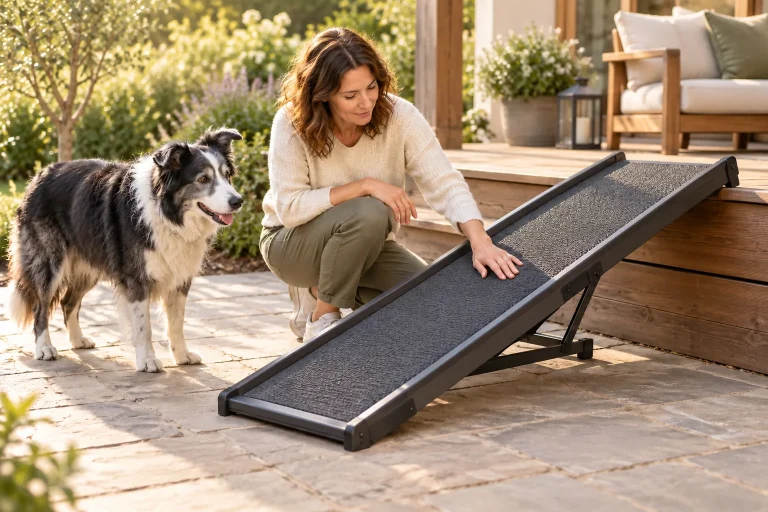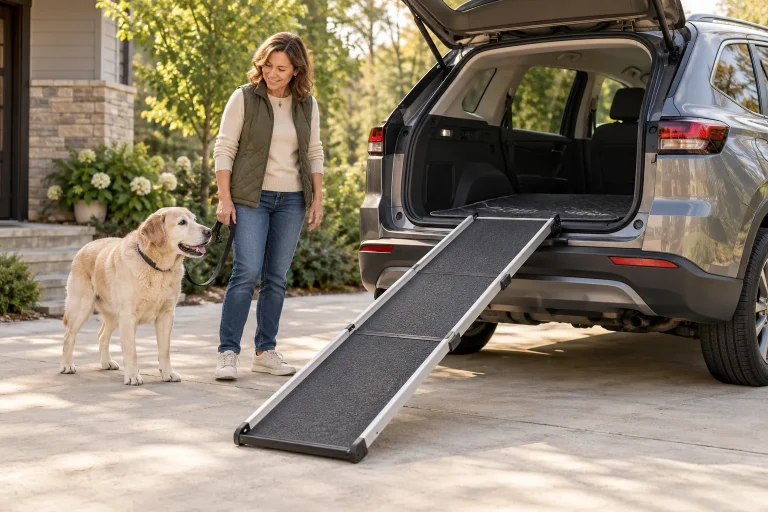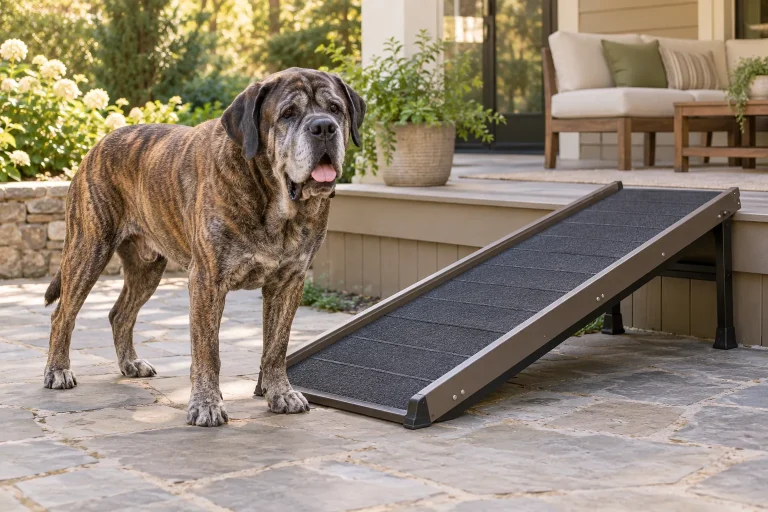
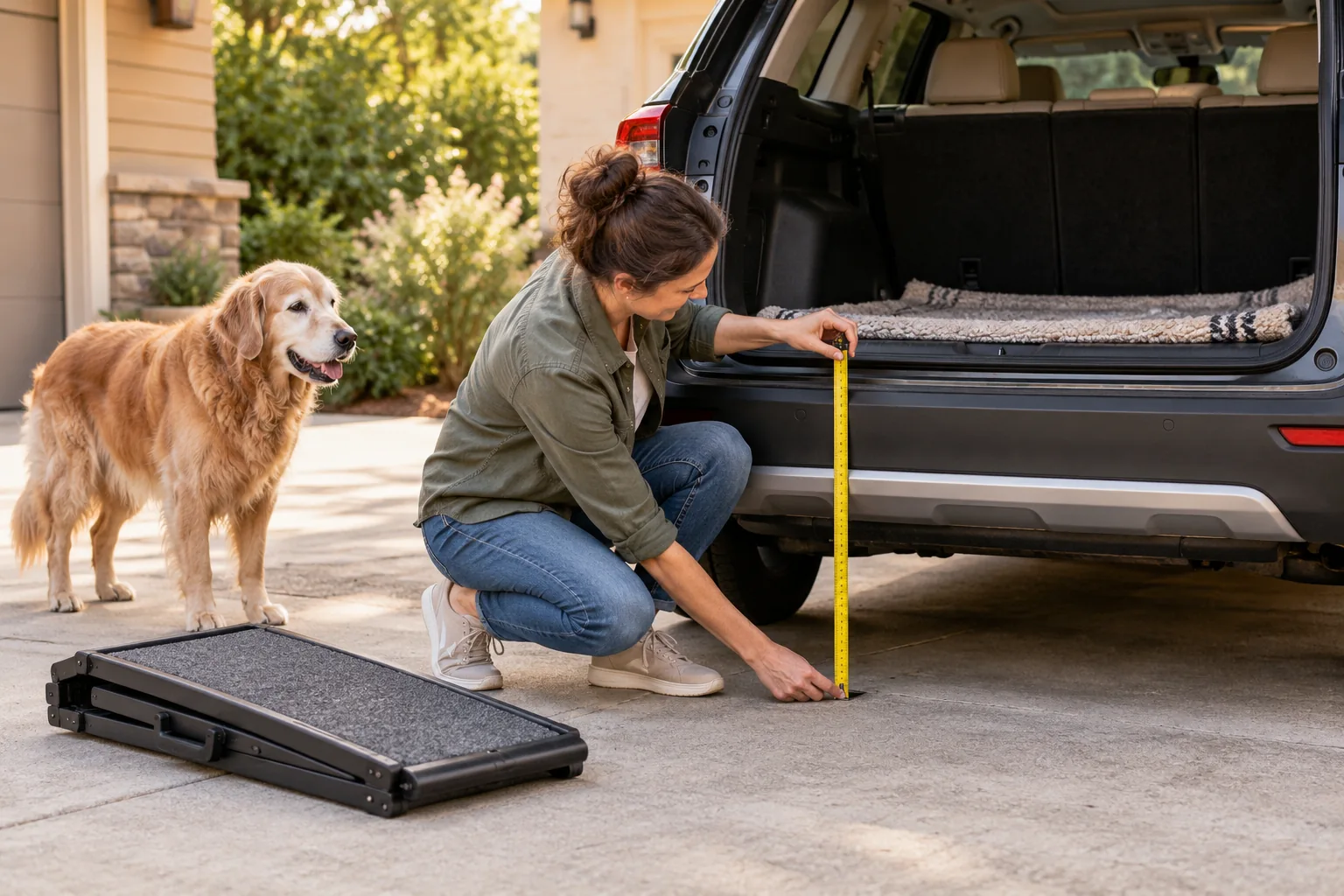
To understand how to measure for a dog ramp, record three things separately: the vertical rise to an approved landing, the usable sloping length of the ramp, and the space available along the ground. Then check clear walking width, the final transition and caregiver access. Measuring only the height of the car or bed leaves several important fit questions unanswered.
This guide provides a practical worksheet and geometry examples. It does not assign a medically suitable angle or replace a veterinary assessment of the dog’s movement. If the dog has pain, weakness, a recent operation or a restricted activity plan, confirm that the proposed route is appropriate before ordering a ramp.
Prepare a simple measuring kit
Use a tape long enough for the expected route, a notepad and, when useful, a level or rigid straightedge. Ask another adult to help hold the tape rather than bending awkwardly or climbing into an unsafe position. Take the dog out of the measuring area; there is no need to involve them while equipment and doors are being moved.
Record the unit beside every number. Inches and centimeters both work, but a calculation must use one unit consistently. Label each measurement in plain language: “ground to cargo-floor landing,” “clear tread width” or “space behind parked vehicle.” A list of unexplained numbers is easy to misread later.
Photograph the intended route and landing if that helps you ask the manufacturer a precise question. Include the door opening and any trim or projecting frame, but do not use a photo as a substitute for measuring. Perspective can make a gap or height difference look smaller than it is.
Measure a vehicle at the actual access point
Park on suitable level ground, secure the vehicle and open the relevant door or tailgate as it will be during use. Measure vertically from the surface supporting the ramp’s lower end to the actual approved upper landing. The cargo floor, bumper and passenger sill can have different heights.
Identify where the ramp will rest or attach according to its instructions. A flexible bumper cover or narrow decorative edge is not automatically a suitable support. If the maker requires overlap, a tether or a compatible adapter, account for that arrangement rather than measuring to an arbitrary point on the car.
Measure the clear door opening and the space immediately inside it. At a side door, check door swing, wheel-arch clearance, seat gaps and the room the dog needs after leaving the ramp. A model that works at a rear cargo opening may not work at a side door, even when the two landings have similar heights.
Repeat the layout at likely destinations
Consider a veterinary-clinic parking area, a familiar travel stop or another place where the ramp must work. You do not need an exact survey of every future location, but you do need a realistic backup if the ground is uneven or there is not enough room. Do not rely on standing in traffic or extending into another vehicle’s path.
For taller vehicles, read model-specific maximum entry-height instructions alongside the dimensions. A right-triangle calculation does not override a manufacturer limit or establish secure top contact. The SUV and truck ramp guide compares designs with those practical restrictions in mind.
Measure beds and couches as complete landings
Measure to the surface where the dog will arrive, not just the frame height. Record the height of the mattress or cushion, any projecting edge and any gap that would remain between the ramp and the usable surface. Soft furnishings may compress or move when loaded; ask how the ramp should connect to that specific layout.
For a fixed-height indoor ramp, compare its top platform with the landing rather than assuming a small mismatch is harmless. A gap, lip or additional step can be important for a dog with limited movement. Do not bridge it with loose cushions or improvised boards.
Mark the proposed footprint in the room without creating a trip hazard. Keep doors, human walking routes, cables and bedside furniture in the plan. The indoor ramp comparison helps distinguish height-adjustable designs from fixed platforms and longer furniture routes.
Understand the triangle before using a calculator
Rise is the vertical height. Run is the horizontal distance along the ground. Sloping length is the walking distance along a straight inclined surface. In a right triangle, the sloping length is longer than the horizontal run.
If you know rise h and usable sloping length L, angle = arcsin(h ÷ L), while run = √(L² − h²). If you instead know rise and available horizontal run r, required straight-line length = √(h² + r²), and angle = arctan(h ÷ r).
These equations describe an ideal straight surface on level ground. They do not include extra approach room, top overlap, bends, sag, platforms or changes in ground level. They also cannot decide how much incline a particular dog should negotiate.
Ramp geometry example
For a straight usable ramp length of 72 inches and a vertical rise of 24 inches, the incline is approximately 19.5° and the horizontal run is approximately 67.9 inches. Allow additional approach, landing and secure contact space.
Geometry only: this example does not determine a suitable angle for an individual dog. Follow the manufacturer’s instructions and the veterinary plan.
Worked example in inches
Suppose a suitable landing is 24 inches above the ground. A straight usable ramp length of 72 inches gives approximately 19.5 degrees of incline and 67.9 inches of horizontal run. The setup needs more space than that run alone because the dog also needs a level approach and room to exit.
If the available ground run were only 48 inches, the straight-line distance from the base to the same landing would be approximately 53.7 inches and the incline approximately 26.6 degrees. This is a description of a constrained layout, not a recommendation to use it. A different route may be necessary.
The same method in centimeters
A 60-centimeter rise and 180-centimeter usable sloping length produce the same approximate 19.5-degree angle, with about 169.7 centimeters of run. The geometry depends on the ratio, so it works with either unit. Convert every measurement before calculating if your product sheet and measuring tape use different units; one inch is exactly 2.54 centimeters.
Ask what the advertised length includes
Shipping-box length, folded length, base footprint and total assembled length can all appear on a product page. Only the relevant usable sloping section belongs in the straight-ramp calculation. Ask for a dimension drawing or manual if the wording is ambiguous.
Some systems have two inclined sections and an intermediate platform. Treating their full end-to-end length as one continuous slope can understate the angle of an individual section. Follow the maker’s layout and assess the separate transitions. Likewise, a fixed-height free-standing ramp’s base length is not automatically its sloping walking length.
On a telescoping design, confirm the approved extension range and stops. On a folding design, check the actual unfolded walking route and upper contact. Do not assume every advertised inch remains available after secure positioning at the landing.
Record the dog’s needs without forcing a test
Record current body weight and ordinary movement observations. Note whether the dog approaches straight, moves sideways, needs assistance or pauses to adjust their feet. Do not make them walk along a narrow improvised plank or step onto a raised object to find a minimum width.
Compare the clear walking surface between rails, not just the product’s outer width. Ask about any narrowing at a hinge or landing. A broad dog and a smaller dog with an unsteady gait can both need more usable space than a weight-based chart suggests.
If a support harness is part of the veterinary plan, include the handler’s position. A wider ramp does not automatically give a person room to stand on it, and a pet load rating is not permission for human use. The large-dog guide explains why width, load and caregiver access need separate consideration.
A measuring worksheet to save
| Measurement or observation | What to write down | Question it answers |
|---|---|---|
| Vertical rise | Ground to approved landing. | What height must be reached? |
| Available horizontal space | Clear run plus approach and exit areas. | Can the whole route fit? |
| Landing detail | Contact depth, lip, gap, trim or cushion movement. | Can the upper transition work as instructed? |
| Clear route width | Door opening, tread between rails and turning room. | Can the dog and assistance plan fit? |
| Storage | Folded dimensions, storage opening and carrying route. | Can the caregiver deploy and secure the ramp? |
| Dog and handling | Weight, observed movement and professional restrictions. | What individual needs must the product accommodate? |
Save the product model and manual alongside the worksheet. When comparing alternatives, use the same landing and the same definition of length for each. Otherwise, a longer-looking product may appear preferable simply because you compared different types of dimensions.
Common measuring errors to avoid
Do not measure a diagonal distance and call it vertical height. Do not use the side-wall height of a truck bed when the dog will enter through a different landing. Do not compare the ramp’s load limit with an old estimate of the dog’s weight.
Avoid rounding away an inconvenient mismatch. A small lip or missing section of upper contact can matter even when the overall numbers seem close. Send the manufacturer the exact measurements and ask for a supported solution instead of assuming a generic accessory will fit.
Finally, do not treat the worksheet as medical clearance. Accurate geometry can reveal an impractical arrangement, but it cannot prove that a route is comfortable for the dog. Combine the measurements with veterinary advice and the ramp selection checklist.
Turn the measurements into a clear manufacturer inquiry
Describe the landing, list the rise and available run with units, identify the exact model and ask how much usable sloping surface remains in its approved setup. Include the proposed upper contact and any door or furniture-frame obstruction. Ask for a dimension drawing if the published labels are unclear.
Save the answer with your worksheet and compare it with the delivered product. If the manufacturer cannot confirm the contact arrangement, do not interpret a close-looking measurement as approval. Choosing a different route or model is more useful than rounding the numbers until the purchase appears to fit.
Frequently asked questions
Should I measure to the bumper or the cargo floor?
Measure to the upper contact or landing the particular ramp is designed to use. Confirm that point with the manual or manufacturer rather than choosing an arbitrary vehicle surface.
Can I calculate incline from height and overall length?
Only when the length represents the relevant usable straight sloping surface. Platforms, multiple segments, folded dimensions and base footprints require different interpretation.
How much extra space should I leave?
Include secure contact and a level approach and exit suited to the dog and handler. There is no universal allowance that establishes suitability for all products and mobility needs.
Do I need to measure again for a new vehicle?
Yes. Landing height, contact shape, door clearance and available space can all change. A ramp that worked before may need a different arrangement.
Sources and editorial basis
- PetSafe: model-specific ramp use and dimensions.
- WeatherTech: segmented EasyRamp layout.
- AKC: route suitability and gradual introduction.
- Numerical examples are original right-triangle calculations, rounded to one decimal place. They are not manufacturer fit approvals or clinical incline recommendations. Sources checked October 17, 2026.
About the author
Grace Wilder
Grace Wilder writes about senior-dog mobility and everyday comfort for PawRampGuide. She covers dog ramps, support harnesses, orthopedic beds, and practical home adjustments, focusing on product fit, ease of use, and clear comparisons. Her goal is to help owners make thoughtful choices that support their aging dogs’ daily routines. Her articles provide general information, with individual health and mobility decisions guided by a veterinarian.